 ChatGPT
 Perplexity
 Google AI Overview


What do AI answers say about skincare brands in Canada?
Two L’Oréal Groupe pharmacy brands lead, the engines disagree about which comes first, and Canadian brands appear almost only when a question asks for them.
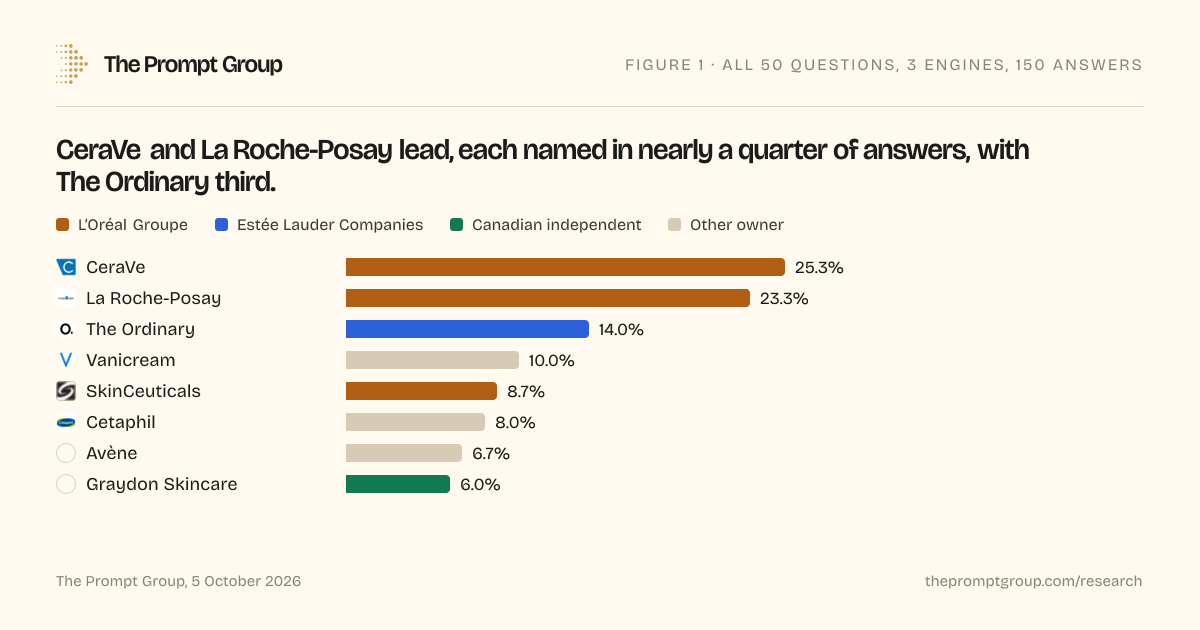
CeraVe was named in 25.3 percent of 150 answers and La Roche-Posay in 23.3; one of the two appears in a third of answers.
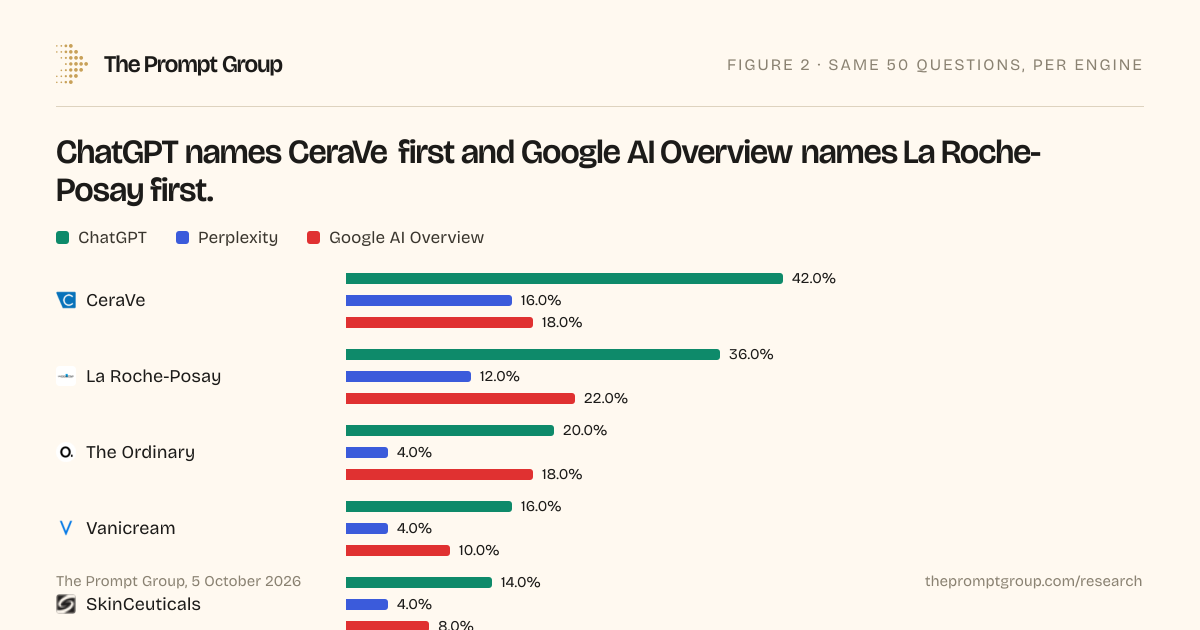
Figure 1ChatGPT named CeraVe most, in 42.0 percent of its answers; Google AI Overview named La Roche-Posay most, in 22.0 percent.
Figure 2Of 105 brands named, 66 appeared on only one engine and 21 on all three.
Figure 2Canadian independent brands took 51 mentions, 46 of them from three questions asking for Canadian-made, clean or cruelty-free skincare.
Figure 1ChatGPT cited the American Academy of Dermatology in 22 of its 50 answers to Canadian skincare questions.
Figure 4Google AI Overview took 21.4 percent of its citations from social media and 2.3 percent from health institutions.
Figure 5
Which skincare questions did we ask AI?
Fifty questions that name no brand, written for the whole category. Commercial questions named a brand in 66.7 percent of answers, informational questions in 6.7 percent.
We wrote the panel around what a Canadian shopper asks while choosing skincare, not around any one brand’s range. It covers skin concerns (10 questions), where to buy in Canada (11), brand choice (9), everyday essentials (7), routines and safety (7) and skin type and life stage (6).
Searchable labels 30 questions commercial, 10 transactional and 10 informational. Each went to ChatGPT, Perplexity and Google AI Overview once, on the evening of 5 October 2026, giving 150 answers.
Brand visibility sits in shortlist questions. Brand choice questions averaged 5.6 brand mentions per answer, while the seven routine and safety questions named a brand in one answer of 21.
A brand that measures itself on how-to questions will find almost nothing to measure, so the commercial half of the panel carries the ranking.
Which skincare brands does AI name most in Canada?
CeraVe, in 25.3 percent of 150 answers, then La Roche-Posay at 23.3, The Ordinary at 14.0, Vanicream at 10.0 and SkinCeuticals at 8.7.
Two L’Oréal Groupe brands lead, and CeraVe or La Roche-Posay appears in 50 of the 150 answers. L’Oréal Groupe brands together appear in 58 answers.
The engines named 105 brands in 338 mentions. Sixty-two were named once, and the two leaders take 21.6 percent of all mentions, so a clear top pair sits above a wide field.
The full ranking
CeraVe and La Roche-Posay lead, each named in nearly a quarter of answers, with The Ordinary third.
- 01CeraVe25.3%
- 02La Roche-Posay23.3%
- 03The Ordinary14.0%
- 04Vanicream10.0%
- 05SkinCeuticals8.7%
- 06Cetaphil8.0%
- 07Avène6.7%
- 08Graydon Skincare6.0%
- 09Three Ships5.3%
- 10Beauty of Joseon4.7%
- 11Anua4.0%
- 12ATTITUDE4.0%
- 13Aveeno4.0%
- 14Province Apothecary4.0%
- 15Skinfix4.0%
- 16Neutrogena3.3%
- 17Vichy3.3%
- 18Bioderma2.7%
- 19COSRX2.7%
- 20Paula's Choice2.7%
- 21Augustinus Bader2.0%
- 22Consonant Skincare2.0%
- 23Differin2.0%
- 24Drunk Elephant2.0%
- 25EltaMD2.0%
- 26First Aid Beauty2.0%
- 27La Mer2.0%
- 28Round Lab2.0%
- 29SKIN10042.0%
- 30Torriden2.0%
- 31Bkind1.3%
- 32Black Girl Sunscreen1.3%
- 33Cocoon Apothecary1.3%
- 34Dr. Barbara Sturm1.3%
- 35e.l.f.1.3%
- 36Estée Lauder1.3%
- 37Eucerin1.3%
- 38Glow Recipe1.3%
- 39Indeed Labs1.3%
- 40Laneige1.3%
- 41Marcelle1.3%
- 42OMY Laboratoires1.3%
- 43Tatcha1.3%
- 44Aestura0.7%
- 45Ageless Beauty Rx0.7%
- 46Alastin0.7%
- 47AmLactin0.7%
- 48Annanda Chaga0.7%
- 49Aquaphor0.7%
- 50Baxter of California0.7%
- 51Biologique Recherche0.7%
- 52Birch Babe0.7%
- 53Bulldog Skincare0.7%
- 54BYOMA0.7%
- 55Caudalie0.7%
- 56Clinique0.7%
- 57Céla0.7%
- 58Dermalogica0.7%
- 59Dr. Dennis Gross0.7%
- 60Dr. Jart+0.7%
- 61Ducray0.7%
- 62Farmacy0.7%
- 63Fresh0.7%
- 64Garnier0.7%
- 65Gloves In A Bottle0.7%
- 66Green Beaver0.7%
- 67innisfree0.7%
- 68Jack Black0.7%
- 69Kiehl's0.7%
- 70KORA Organics0.7%
- 71La Prairie0.7%
- 72Lab Series0.7%
- 73Live Tinted0.7%
- 74Living Libations0.7%
- 75Medicube0.7%
- 76Naturium0.7%
- 77O'Keeffe's0.7%
- 78Olay0.7%
- 79Ombrelle0.7%
- 80PanOxyl0.7%
- 81Paume0.7%
- 82Purito0.7%
- 83Reversa0.7%
- 84Revision Skincare0.7%
- 85Riversol0.7%
- 86RoC0.7%
- 87Rocky Mountain Soap Company0.7%
- 88Sahajan0.7%
- 89Shiva's Delight0.7%
- 90Simple0.7%
- 91SK-II0.7%
- 92SkinMedica0.7%
- 93Summer Fridays0.7%
- 94Tata Harper0.7%
- 95The INKEY List0.7%
- 96The Vancouver Aesthetician0.7%
- 97TIRTIR0.7%
- 98TruSkin0.7%
- 99Uriage0.7%
- 100Ursa Major0.7%
- 101Vasanti Cosmetics0.7%
- 102Vaseline0.7%
- 103Vivier0.7%
- 104Wildcraft0.7%
- 105Youth To The People0.7%
Data behind Figure 1
Share of the 150 answers to unbranded questions that name each brand, in one run. The Prompt Group, 5 October 2026.
Every brand named is listed, 105 in all, and the page shows the first 15. Parent company and Canadian independent are our classification, as of October 2026. Four duplicate roster names are merged.
| Name | Value | Answers naming it |
|---|---|---|
| CeraVe | 25.3% | 38 of 150 |
| La Roche-Posay | 23.3% | 35 of 150 |
| The Ordinary | 14.0% | 21 of 150 |
| Vanicream | 10.0% | 15 of 150 |
| SkinCeuticals | 8.7% | 13 of 150 |
| Cetaphil | 8.0% | 12 of 150 |
| Avène | 6.7% | 10 of 150 |
| Graydon Skincare | 6.0% | 9 of 150 |
| Three Ships | 5.3% | 8 of 150 |
| Beauty of Joseon | 4.7% | 7 of 150 |
| Anua | 4.0% | 6 of 150 |
| ATTITUDE | 4.0% | 6 of 150 |
| Aveeno | 4.0% | 6 of 150 |
| Province Apothecary | 4.0% | 6 of 150 |
| Skinfix | 4.0% | 6 of 150 |
| Neutrogena | 3.3% | 5 of 150 |
| Vichy | 3.3% | 5 of 150 |
| Bioderma | 2.7% | 4 of 150 |
| COSRX | 2.7% | 4 of 150 |
| Paula's Choice | 2.7% | 4 of 150 |
| Augustinus Bader | 2.0% | 3 of 150 |
| Consonant Skincare | 2.0% | 3 of 150 |
| Differin | 2.0% | 3 of 150 |
| Drunk Elephant | 2.0% | 3 of 150 |
| EltaMD | 2.0% | 3 of 150 |
| First Aid Beauty | 2.0% | 3 of 150 |
| La Mer | 2.0% | 3 of 150 |
| Round Lab | 2.0% | 3 of 150 |
| SKIN1004 | 2.0% | 3 of 150 |
| Torriden | 2.0% | 3 of 150 |
| Bkind | 1.3% | 2 of 150 |
| Black Girl Sunscreen | 1.3% | 2 of 150 |
| Cocoon Apothecary | 1.3% | 2 of 150 |
| Dr. Barbara Sturm | 1.3% | 2 of 150 |
| e.l.f. | 1.3% | 2 of 150 |
| Estée Lauder | 1.3% | 2 of 150 |
| Eucerin | 1.3% | 2 of 150 |
| Glow Recipe | 1.3% | 2 of 150 |
| Indeed Labs | 1.3% | 2 of 150 |
| Laneige | 1.3% | 2 of 150 |
| Marcelle | 1.3% | 2 of 150 |
| OMY Laboratoires | 1.3% | 2 of 150 |
| Tatcha | 1.3% | 2 of 150 |
| Aestura | 0.7% | 1 of 150 |
| Ageless Beauty Rx | 0.7% | 1 of 150 |
| Alastin | 0.7% | 1 of 150 |
| AmLactin | 0.7% | 1 of 150 |
| Annanda Chaga | 0.7% | 1 of 150 |
| Aquaphor | 0.7% | 1 of 150 |
| Baxter of California | 0.7% | 1 of 150 |
| Biologique Recherche | 0.7% | 1 of 150 |
| Birch Babe | 0.7% | 1 of 150 |
| Bulldog Skincare | 0.7% | 1 of 150 |
| BYOMA | 0.7% | 1 of 150 |
| Caudalie | 0.7% | 1 of 150 |
| Clinique | 0.7% | 1 of 150 |
| Céla | 0.7% | 1 of 150 |
| Dermalogica | 0.7% | 1 of 150 |
| Dr. Dennis Gross | 0.7% | 1 of 150 |
| Dr. Jart+ | 0.7% | 1 of 150 |
| Ducray | 0.7% | 1 of 150 |
| Farmacy | 0.7% | 1 of 150 |
| Fresh | 0.7% | 1 of 150 |
| Garnier | 0.7% | 1 of 150 |
| Gloves In A Bottle | 0.7% | 1 of 150 |
| Green Beaver | 0.7% | 1 of 150 |
| innisfree | 0.7% | 1 of 150 |
| Jack Black | 0.7% | 1 of 150 |
| Kiehl's | 0.7% | 1 of 150 |
| KORA Organics | 0.7% | 1 of 150 |
| La Prairie | 0.7% | 1 of 150 |
| Lab Series | 0.7% | 1 of 150 |
| Live Tinted | 0.7% | 1 of 150 |
| Living Libations | 0.7% | 1 of 150 |
| Medicube | 0.7% | 1 of 150 |
| Naturium | 0.7% | 1 of 150 |
| O'Keeffe's | 0.7% | 1 of 150 |
| Olay | 0.7% | 1 of 150 |
| Ombrelle | 0.7% | 1 of 150 |
| PanOxyl | 0.7% | 1 of 150 |
| Paume | 0.7% | 1 of 150 |
| Purito | 0.7% | 1 of 150 |
| Reversa | 0.7% | 1 of 150 |
| Revision Skincare | 0.7% | 1 of 150 |
| Riversol | 0.7% | 1 of 150 |
| RoC | 0.7% | 1 of 150 |
| Rocky Mountain Soap Company | 0.7% | 1 of 150 |
| Sahajan | 0.7% | 1 of 150 |
| Shiva's Delight | 0.7% | 1 of 150 |
| Simple | 0.7% | 1 of 150 |
| SK-II | 0.7% | 1 of 150 |
| SkinMedica | 0.7% | 1 of 150 |
| Summer Fridays | 0.7% | 1 of 150 |
| Tata Harper | 0.7% | 1 of 150 |
| The INKEY List | 0.7% | 1 of 150 |
| The Vancouver Aesthetician | 0.7% | 1 of 150 |
| TIRTIR | 0.7% | 1 of 150 |
| TruSkin | 0.7% | 1 of 150 |
| Uriage | 0.7% | 1 of 150 |
| Ursa Major | 0.7% | 1 of 150 |
| Vasanti Cosmetics | 0.7% | 1 of 150 |
| Vaseline | 0.7% | 1 of 150 |
| Vivier | 0.7% | 1 of 150 |
| Wildcraft | 0.7% | 1 of 150 |
| Youth To The People | 0.7% | 1 of 150 |
CeraVe and La Roche-Posay lead on general questions about dry skin, sensitivity and cleansers, where no ingredient or price points to a specialist. That is consistent with the engines treating dermatologist-associated pharmacy brands as the default answer to an unbranded question.
Below the top four, one or two answers separate most brands. Figure 1 lists all 105, and every brand named has a page of its own.
Does ChatGPT name the same skincare brands as Google AI Overview?
No. ChatGPT names CeraVe most, in 42.0 percent of its answers, and Google AI Overview names La Roche-Posay most, in 22.0 percent.
ChatGPT names La Roche-Posay second, at 36.0 percent, and The Ordinary third at 20.0. Google AI Overview names CeraVe and The Ordinary level, at 18.0 percent each.
The engines overlap less than their leaders suggest. Of 105 brands, 21 were named by all three engines and 66 by only one.
Engine by engine
ChatGPT names CeraVe first and Google AI Overview names La Roche-Posay first.
- 01CeraVe42.0%16.0%18.0%
- 02La Roche-Posay36.0%12.0%22.0%
- 03The Ordinary20.0%4.0%18.0%
- 04Vanicream16.0%4.0%10.0%
- 05SkinCeuticals14.0%4.0%8.0%
- 06Avène12.0%6.0%2.0%
- 07Cetaphil8.0%8.0%8.0%
- 08Graydon Skincare6.0%4.0%8.0%
- 09Three Ships6.0%2.0%8.0%
- 10Beauty of Joseon8.0%4.0%2.0%
- 11Anua4.0%2.0%6.0%
- 12ATTITUDE6.0%2.0%4.0%
- 13Aveeno2.0%6.0%4.0%
- 14Skinfix6.0%2.0%4.0%
- 15Neutrogena2.0%6.0%2.0%
- 16Vichy6.0%2.0%2.0%
- 17Bioderma6.0%2.0%0
- 18Province Apothecary4.0%4.0%4.0%
- 19COSRX2.0%2.0%4.0%
- 20Paula's Choice4.0%04.0%
- 21Augustinus Bader4.0%02.0%
- 22Consonant Skincare2.0%4.0%0
- 23Differin4.0%02.0%
- 24Drunk Elephant4.0%02.0%
- 25EltaMD4.0%02.0%
- 26First Aid Beauty4.0%02.0%
- 27La Mer4.0%02.0%
- 28Bkind4.0%00
- 29Dr. Barbara Sturm4.0%00
- 30e.l.f.004.0%
- 31Marcelle4.0%00
- 32Round Lab2.0%2.0%2.0%
- 33SKIN10042.0%2.0%2.0%
- 34Torriden2.0%2.0%2.0%
- 35Black Girl Sunscreen2.0%2.0%0
- 36Cocoon Apothecary2.0%02.0%
- 37Estée Lauder2.0%02.0%
- 38Eucerin2.0%2.0%0
- 39Glow Recipe2.0%02.0%
- 40Indeed Labs2.0%2.0%0
- 41Laneige2.0%02.0%
- 42OMY Laboratoires2.0%2.0%0
- 43Tatcha2.0%02.0%
- 44Aestura02.0%0
- 45Ageless Beauty Rx02.0%0
- 46Alastin02.0%0
- 47AmLactin2.0%00
- 48Annanda Chaga002.0%
- 49Aquaphor002.0%
- 50Baxter of California002.0%
- 51Biologique Recherche2.0%00
- 52Birch Babe002.0%
- 53Bulldog Skincare002.0%
- 54BYOMA002.0%
- 55Caudalie002.0%
- 56Clinique2.0%00
- 57Céla002.0%
- 58Dermalogica002.0%
- 59Dr. Dennis Gross002.0%
- 60Dr. Jart+002.0%
- 61Ducray2.0%00
- 62Farmacy2.0%00
- 63Fresh2.0%00
- 64Garnier2.0%00
- 65Gloves In A Bottle02.0%0
- 66Green Beaver2.0%00
- 67innisfree002.0%
- 68Jack Black2.0%00
- 69Kiehl's2.0%00
- 70KORA Organics2.0%00
- 71La Prairie002.0%
- 72Lab Series002.0%
- 73Live Tinted2.0%00
- 74Living Libations2.0%00
- 75Medicube2.0%00
- 76Naturium002.0%
- 77O'Keeffe's2.0%00
- 78Olay2.0%00
- 79Ombrelle2.0%00
- 80PanOxyl2.0%00
- 81Paume02.0%0
- 82Purito2.0%00
- 83Reversa2.0%00
- 84Revision Skincare02.0%0
- 85Riversol02.0%0
- 86RoC2.0%00
- 87Rocky Mountain Soap Company2.0%00
- 88Sahajan2.0%00
- 89Shiva's Delight002.0%
- 90Simple2.0%00
- 91SK-II2.0%00
- 92SkinMedica002.0%
- 93Summer Fridays002.0%
- 94Tata Harper2.0%00
- 95The INKEY List2.0%00
- 96The Vancouver Aesthetician02.0%0
- 97TIRTIR002.0%
- 98TruSkin002.0%
- 99Uriage2.0%00
- 100Ursa Major002.0%
- 101Vasanti Cosmetics002.0%
- 102Vaseline002.0%
- 103Vivier2.0%00
- 104Wildcraft2.0%00
- 105Youth To The People2.0%00
Data behind Figure 2
Share of each engine’s 50 answers that name each brand, in one run. The Prompt Group, 5 October 2026.
Every brand named is listed. Six Google AI Overview answers came back empty and count as naming nobody. Twenty Perplexity answers rest on unrelated sources; see the section on Perplexity.
With one answer per question, a gap of two or three answers could close on the next run, so read CeraVe and La Roche-Posay as a pair. The engines agree on the pair and disagree on the order.
The Ordinary depends most on the engine: 20.0 percent on ChatGPT, 18.0 on Google AI Overview and 4.0 on Perplexity. A blended score would hide that spread.
Do AI engines name Canadian skincare brands?
Mostly when the question asks for one. Nineteen Canadian independent brands were named, and 46 of their 51 mentions came from three questions about Canadian-made, clean and cruelty-free skincare.
Graydon Skincare leads them, in 9 answers, then Three Ships in 8 and ATTITUDE and Province Apothecary in 6 each. The question about brands made in Canada produced 21 of their mentions.
The two markets barely touch. CeraVe and La Roche-Posay were named in none of the nine answers to those three questions, and in 50 of the 141 answers to the other 47.
The engines appear to treat Canadian origin as a filter a shopper applies, and rarely volunteer it. On general questions about dry or sensitive skin, Canadian independent brands have almost no visibility in this collection.
For a Canadian brand, being named on a made-in-Canada list does not carry into the shortlists where most buying questions are answered.
How reliable were Perplexity’s answers about skincare brands in Canada?
Not reliable in this collection. In 20 of Perplexity’s 50 answers, at least half of the cited sources have nothing to do with skincare.
We read all 50 Perplexity answers with their sources. The failed answers cite music streaming pages, dictionaries, fandom wikis and schools. Most still read as on-topic, and six name brands, which suggests the text came from the model rather than from the pages it cited.
Perplexity’s answers were also short, with a median of about 430 characters against about 1,970 for ChatGPT. It named a brand in 17 of its 50 answers.
The pattern is consistent with a retrieval fault in the Perplexity channel Searchable queried. We cannot tell whether the consumer Perplexity app behaved the same way.
Perplexity’s brand figures are in Figure 2 for completeness. Its citations stay in the source counts, where they make up most of the unclassified share.
How many skincare brands does each AI engine name?
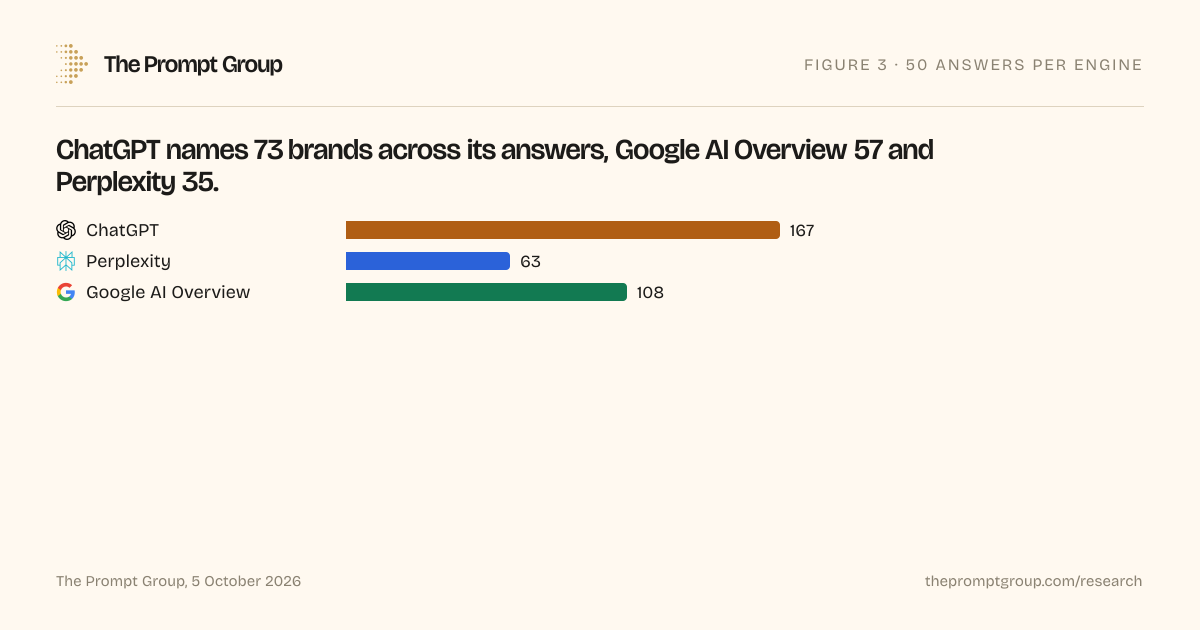
ChatGPT named 73 brands in 167 mentions, Google AI Overview 57 brands in 108 and Perplexity 35 brands in 63, each across 50 answers.
ChatGPT named a brand in 34 of its 50 answers, Google AI Overview in 27 and Perplexity in 17. On the 30 commercial questions, ChatGPT named CeraVe and La Roche-Posay in 16 answers each.
Six Google AI Overview answers came back empty, all on questions that ask for a product, a brand or a place to buy. We cannot tell a refusal from a question that did not trigger an overview.
How much each engine names
ChatGPT names 73 brands across its answers, Google AI Overview 57 and Perplexity 35.
- 167ChatGPT
- 63Perplexity
- 108Google AI Overview
Data behind Figure 3
Brand mentions across each engine’s 50 answers, in one run. The Prompt Group, 5 October 2026.
| Name | Value | Brands named | Answers naming a brand |
|---|---|---|---|
| ChatGPT | 167 | 73 | 34 of 50 |
| Perplexity | 63 | 35 | 17 of 50 |
| Google AI Overview | 108 | 57 | 27 of 50 |
A longer answer names more brands, so one mention on ChatGPT says less about preference than a place on Google AI Overview’s shorter list.
The empty answers sit where brands are named, so a brand tracking Google AI Overview should count them before reading a share.
Which sources do AI answers cite about skincare brands in Canada?
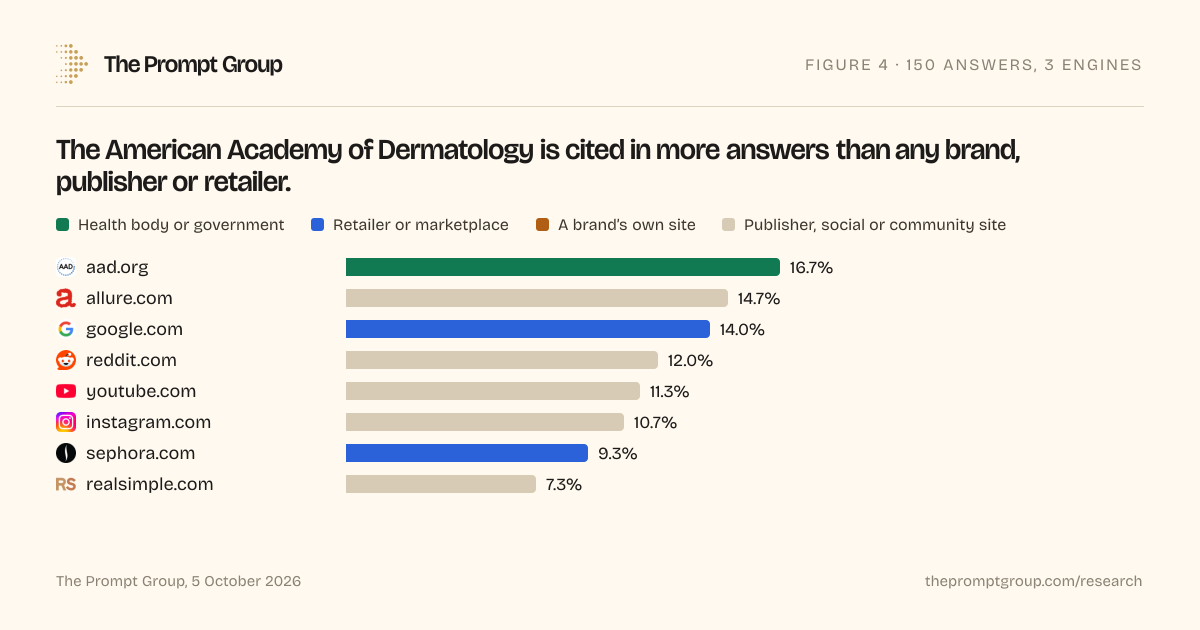
aad.org, the American Academy of Dermatology, cited in 16.7 percent of 150 answers, then allure.com at 14.7, google.com at 14.0 and reddit.com at 12.0.
The answers carry 1,797 citations to 620 domains. ChatGPT accounts for 22 of the 25 answers citing aad.org, a US body, while dermatology.ca, the Canadian Dermatology Association, is cited in 8. Google AI Overview accounts for 19 of the 21 answers citing google.com, all of them Google Shopping listings.
Brand sites are rarely the evidence. CeraVe is named in 38 answers and its own site is cited in 5, and La Roche-Posay in 35 and 5.
Most cited domains
The American Academy of Dermatology is cited in more answers than any brand, publisher or retailer.
- 01aad.org16.7%
- 02allure.com14.7%
- 03google.com14.0%
- 04reddit.com12.0%
- 05youtube.com11.3%
- 06instagram.com10.7%
- 07sephora.com9.3%
- 08realsimple.com7.3%
- 09nbcnews.com6.7%
- 10vogue.com6.7%
- 11facebook.com5.3%
- 12tiktok.com5.3%
- 13ellecanada.com5.3%
- 14nih.gov4.7%
- 15canada.ca4.7%


Data behind Figure 4
Share of the 150 answers that cite each domain at least once, in one run. The Prompt Group, 5 October 2026.
A citation is a distinct page linked in an answer, counted once per answer, with subdomains under their domain. google.com is Google Shopping listings cited by Google AI Overview. Type is our classification.
| Domain | Value | Citations | Pages cited |
|---|---|---|---|
| aad.org | 16.7% | 225 | 116 |
| allure.com | 14.7% | 40 | 23 |
| google.com | 14.0% | 49 | 45 |
| reddit.com | 12.0% | 28 | 28 |
| youtube.com | 11.3% | 37 | 37 |
| instagram.com | 10.7% | 23 | 23 |
| sephora.com | 9.3% | 42 | 37 |
| realsimple.com | 7.3% | 13 | 6 |
| nbcnews.com | 6.7% | 12 | 11 |
| vogue.com | 6.7% | 11 | 10 |
| facebook.com | 5.3% | 11 | 11 |
| tiktok.com | 5.3% | 9 | 9 |
| ellecanada.com | 5.3% | 8 | 6 |
| nih.gov | 4.7% | 52 | 52 |
| canada.ca | 4.7% | 34 | 28 |
The leading brands appear to reach answers through dermatology bodies, beauty publishers and Google’s catalogue more than through their own pages.
For a Canadian brand, the exposure is that ChatGPT answers Canadian skincare questions largely from a US professional body’s pages, which no brand writes.
What kinds of sources do AI answers cite about skincare brands in Canada?
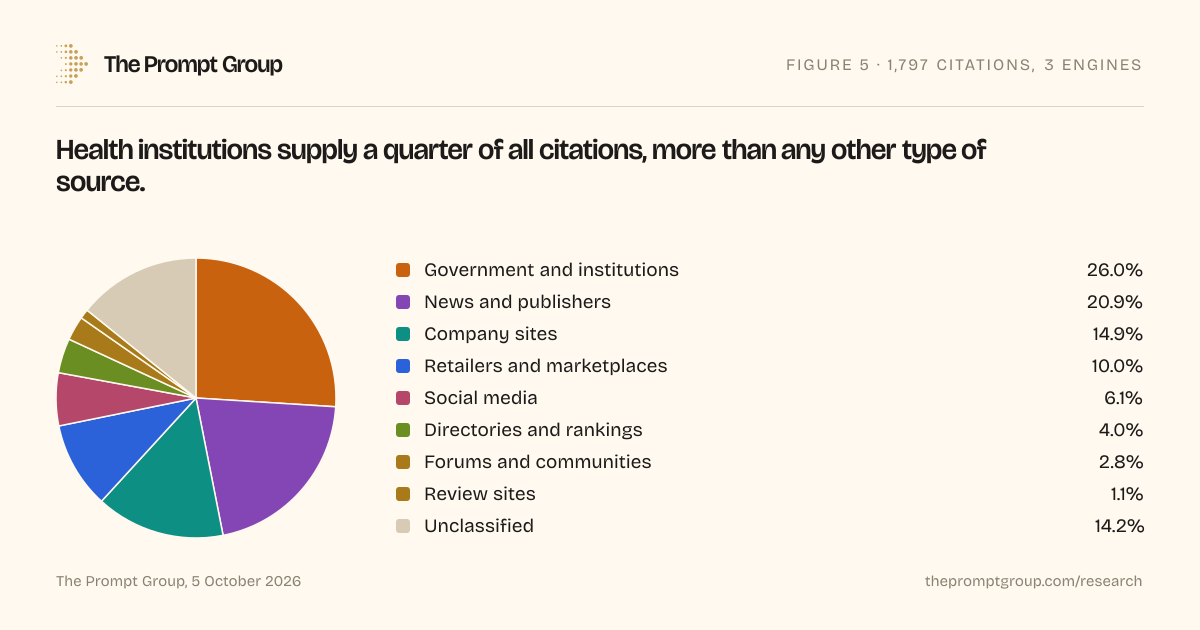
Government and health institutions, with 26.0 percent of 1,797 citations, then news and publishers at 20.9 and company sites at 14.9.
The mix differs sharply by engine. ChatGPT takes 40.3 percent of its citations from institutions, led by aad.org, nih.gov and canada.ca. Google AI Overview takes 21.4 percent from social media, mostly Instagram, YouTube, TikTok and Facebook, and 20.1 percent from retailers, against 2.3 percent from institutions.
Unclassified is 14.2 percent, mostly the unrelated sources in Perplexity’s answers. Review sites supply 1.1 percent.
Sources by type
Health institutions supply a quarter of all citations, more than any other type of source.
- Government and institutions26.0%467
- News and publishers20.9%375
- Company sites14.9%268
- Retailers and marketplaces10.0%179
- Social media6.1%110
- Directories and rankings4.0%72
- Forums and communities2.8%50
- Review sites1.1%20
- Unclassified14.2%256
Data behind Figure 5
Share of all 1,797 citations by type of source, across three engines in one run. The Prompt Group, 5 October 2026.
Type is set per domain: Searchable’s label where it gave one, and our own for 124 more, every retailer included. Most unclassified citations are the unrelated sources in Perplexity’s answers.
| Name | Value | Citations |
|---|---|---|
| Government and institutions | 26.0% | 467 |
| News and publishers | 20.9% | 375 |
| Company sites | 14.9% | 268 |
| Retailers and marketplaces | 10.0% | 179 |
| Social media | 6.1% | 110 |
| Directories and rankings | 4.0% | 72 |
| Forums and communities | 2.8% | 50 |
| Review sites | 1.1% | 20 |
| Unclassified | 14.2% | 256 |
ChatGPT and Google AI Overview build skincare answers from opposite ends of the evidence. ChatGPT reads clinical and regulatory pages, and Google AI Overview reads creator video, social posts and shopping listings.
A brand can supply accurate material to both, but the work differs: clinical evidence for one engine, creator and product-listing content for the other.
What should a skincare brand in Canada do about this?
Measure each engine separately on shopping questions, test general questions as well as Canadian ones, and know which institutions and creators the engines read.
Measure each engine as a separate market. CeraVe leads ChatGPT and La Roche-Posay leads Google AI Overview on the same questions, and The Ordinary ranges from 20.0 percent on ChatGPT to 4.0 on Perplexity. A blended score hides the engine a brand most needs to work on.
Track the shopping questions. Commercial questions named a brand in 66.7 percent of answers and informational questions in 6.7 percent. A panel weighted towards how-to questions measures the part of the category where brands are rarely named.
Test general questions, not only Canadian ones. Canadian independent brands took 46 of their 51 mentions from three questions that ask for Canadian, clean or cruelty-free skincare. Visibility on a made-in-Canada list says little about the shortlists for dry or sensitive skin.
Know which sources the engines read. ChatGPT cited the American Academy of Dermatology in 22 of 50 answers, and Google AI Overview took a fifth of its citations from social media. Those are the sources to check before changing a brand’s own pages.
Check a collection before trusting it. Twenty of Perplexity’s 50 answers rested on unrelated sources. A visibility score built on that channel would have reported a collection fault as a market position.
How was this skincare AI visibility study measured?
50 questions that name no brand, put to ChatGPT, Perplexity and Google AI Overview once on 5 October 2026, giving 150 answers counted against a roster of 193 brands.
What we asked, word for word8 of the panel
- What is a good gentle cleanser for sensitive skin?
- What is the best moisturizer for dry skin in a Canadian winter?
- Which skincare brands are best for acne-prone skin?
- Which face sunscreens sold in Canada don’t leave a white cast?
- What skincare products do dermatologists in Canada recommend most?
- Which skincare brands are made in Canada?
- Where is the best place to buy skincare online in Canada?
- Which luxury skincare brands are actually worth the money?
- Panel
- 50 questions we wrote for the category, none naming a brand or a retailer. They replace a first set generated from one brand’s website, which named that brand’s signature ingredients and price points and skewed the ranking towards it.
- Topics and intent
- Where to buy in Canada 11 questions, skin concerns and treatments 10, brand choice and value 9, everyday essentials 7, routines and safety 7, skin type and life stage 6. Searchable labels 30 questions commercial, 10 transactional and 10 informational.
- Geography
- Run with the country set to Canada and English prompts. Four questions name a city, Toronto, Vancouver, Calgary and Montreal, and three of those were run from that city.
- Collection
- One run on 5 October 2026, at about 8:16 pm Eastern. 50 questions across three engines is 150 answers, 50 per engine. Six Google AI Overview answers came back empty.
- Answer share
- The percentage of the 150 answers, or of one engine’s 50, in which a brand was named. It is not market share, sales or recommendation. One answer can name several brands, so shares do not sum to 100.
- How brands were counted
- Searchable matches each answer against a roster of 193 brands, so a brand outside the roster is not counted. Four pairs of roster names are one brand and are merged. Every brand named is in Figures 1 and 2, and the page shows the first 15.
- Parent companies
- L’Oréal Groupe, Estée Lauder Companies, Canadian independent and other owner are our classification, as of October 2026. Canadian independent means founded and run in Canada and not owned by a multinational, so The Ordinary counts under Estée Lauder Companies.
- Citations
- A citation is a distinct page linked in an answer, counted once per answer. The 2,304 links recorded become 1,797 citations. Subdomains count under their registrable domain.
- Source types
- Each cited domain gets one type: Searchable’s label where it gave one, fixed lists for social networks and forums, and our own label for 124 more domains. Retailers and marketplaces is a type we added for this category, and google.com sits in it.
- What we read
- We read all 50 Perplexity answers with their sources. The classification of its unrelated answers is ours and is published with the data.
- Frozen extract
- The project keeps collecting. These figures are the run of 5 October 2026, pulled through the Searchable API the same day and available on request.
- Limitations
- This is one run, so every share rests on one answer per question per engine; one answer moves a brand by 0.7 points overall and 2.0 points on one engine. Read differences of a few answers as noise and the order of CeraVe and La Roche-Posay as a tie. Twenty Perplexity answers rested on unrelated sources and six Google AI Overview answers were empty, so both engines’ shares are floors. The roster was built in a project set up around The Ordinary’s domain; 105 brands matched and the true number named is higher. Retailers and clinics are not counted as brands unless the roster lists them. The panel is 50 questions in English, and its intent labels are Searchable’s.
Cite this report
Sopov, A. (2026). The Prompt Group Research. https://thepromptgroup.com/research/skincare-brands/ca
Figures and data are free to reuse with attribution under CC BY 4.0. Every chart is available as a PNG carrying its source line, and every dataset as CSV and JSON.
What do people ask about AI search and skincare brands in Canada?
Which brand each AI engine names in Canada, which sources it cites, and how a brand should read its own visibility, all from the 5 October 2026 collection.
Which skincare brand does AI recommend in Canada?
Across 150 answers to 50 unbranded questions on 5 October 2026, CeraVe was named most, in 25.3 percent. La Roche-Posay followed at 23.3 percent, The Ordinary at 14.0, Vanicream at 10.0 and SkinCeuticals at 8.7.
Which skincare brand does ChatGPT recommend in Canada?
CeraVe, named in 42.0 percent of ChatGPT’s 50 answers on 5 October 2026. La Roche-Posay followed at 36.0 percent and The Ordinary at 20.0.
Which skincare brand does Google AI Overview name in Canada?
La Roche-Posay, named in 22.0 percent of Google AI Overview’s 50 answers on 5 October 2026. CeraVe and The Ordinary followed, at 18.0 percent each.
Does AI recommend Canadian skincare brands?
Mostly when asked. Nineteen Canadian independent brands were named, led by Graydon Skincare and Three Ships, and 46 of their 51 mentions came from questions asking for Canadian-made, clean or cruelty-free skincare.
Which sources does AI cite about skincare in Canada?
aad.org, the American Academy of Dermatology, was cited in 25 of 150 answers, 22 of them on ChatGPT. Health institutions supplied 26.0 percent of 1,797 citations, publishers 20.9 percent and company sites 14.9 percent.
How should a skincare brand measure its AI visibility?
Engine by engine, on shopping questions. ChatGPT and Google AI Overview put different brands first, and commercial questions name a brand 66.7 percent of the time against 6.7 for informational questions.
Written by
Founder, The Prompt Group
Anton Sopov is the founder of The Prompt Group, an AI brand strategy and agentic discovery firm. He works with brands on how they are ranked, cited and described in ChatGPT, Claude, Gemini and Perplexity answers, and is the author of The Delegation Curve.
 Canada
 United States
 United Kingdom
 Australia