

 ChatGPT
 Perplexity
 Google AI Overview
 CrowdStrike
 Arctic Wolf
 Sophos
 eSentire
What do AI answers say about Canadian cybersecurity providers?
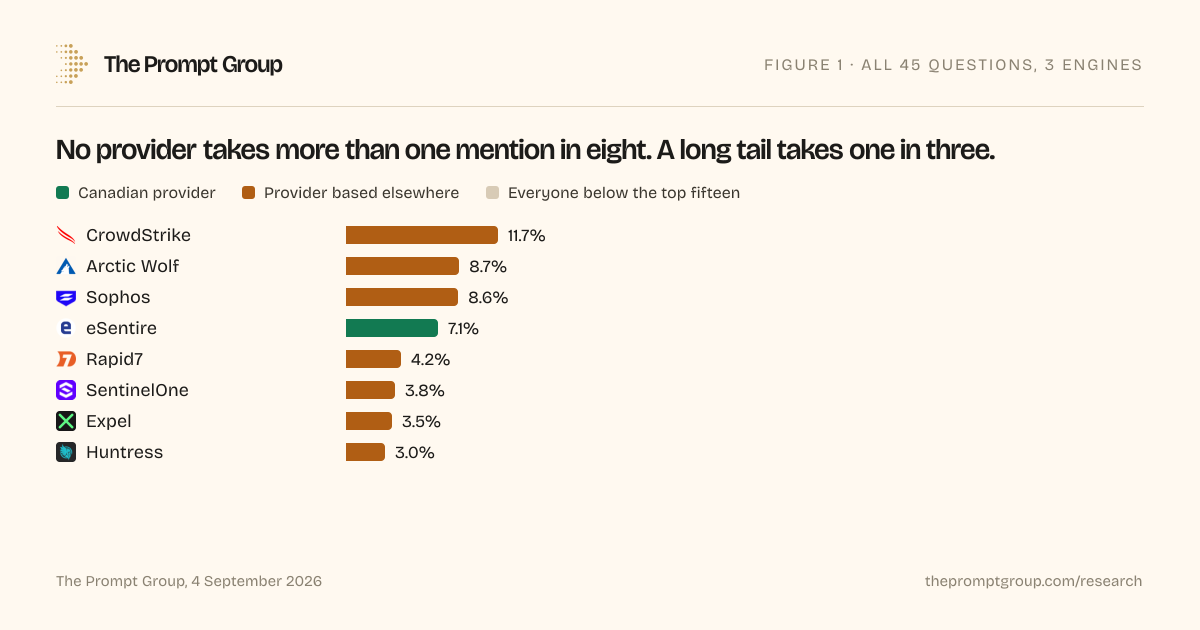
- No provider owns Canadian cybersecurity in AI answers. CrowdStrike leads on 11.7 percent of provider mentions, the fifteen most-named take 64.4 percent between them, and 161 other companies split the remaining 35.6.Figure 1, share of provider mentions
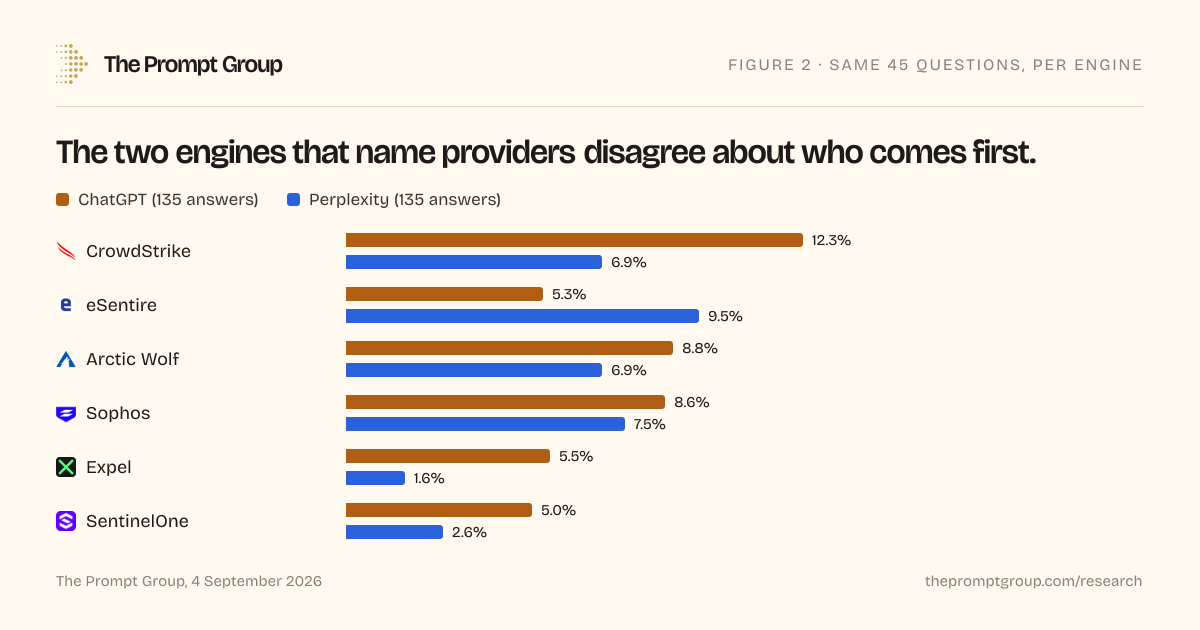
- ChatGPT and Perplexity rank the same four companies in almost opposite order. CrowdStrike is first in ChatGPT on 12.3 percent and fourth in Perplexity on 6.9. eSentire is fifth in ChatGPT on 5.3 and first in Perplexity on 9.5.Figure 2, ChatGPT versus Perplexity
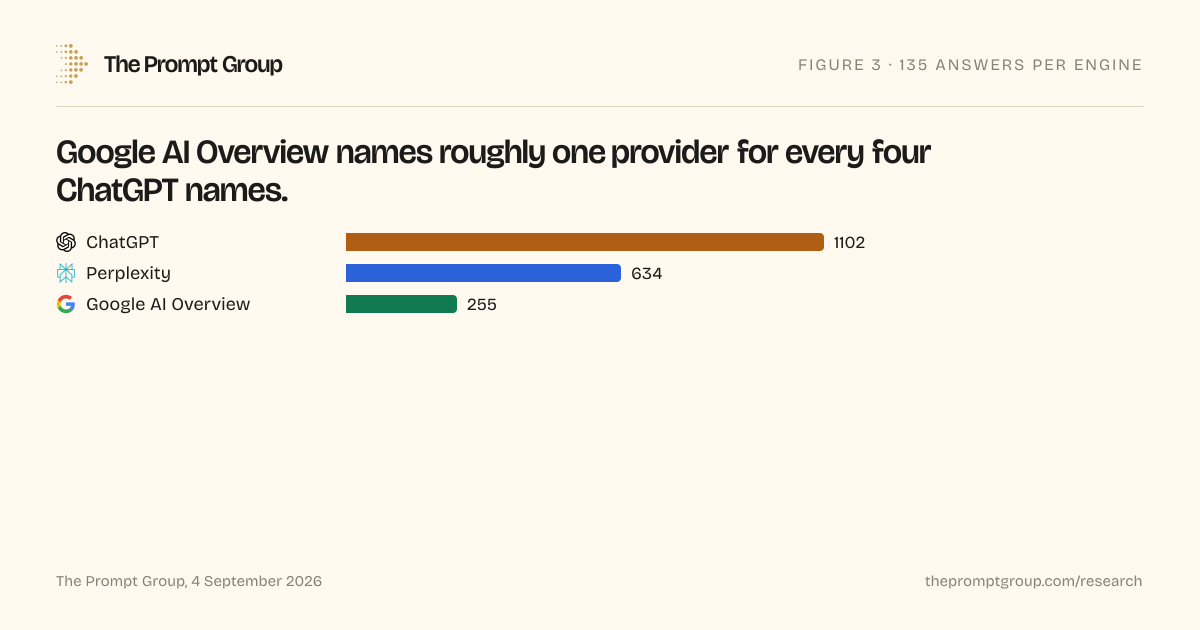
- Google AI Overview names a cybersecurity vendor a quarter as often as ChatGPT. It gave 255 provider mentions across 135 answers, covering 37 companies. ChatGPT gave 1,102, covering 111.Figure 3, mentions by engine
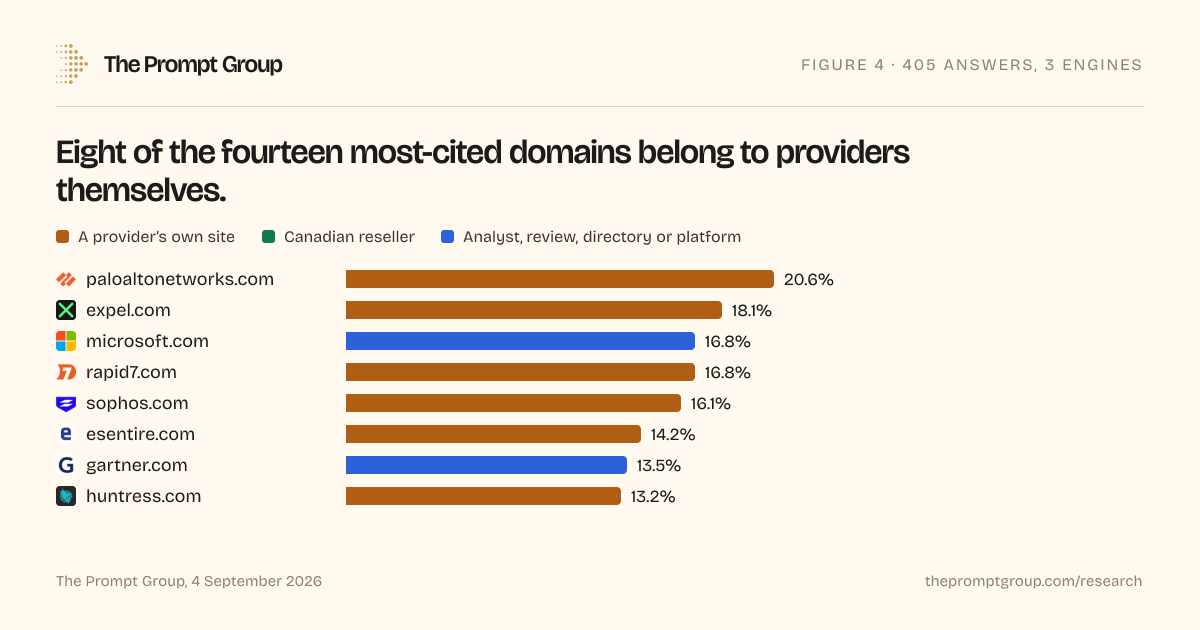
- Vendor documentation is doing the recommending. Eight of the fourteen most-cited domains are provider sites, and the pages being cited are topic guides, comparisons and ranked lists rather than campaign pages.Figure 4, most-cited domains
Which cybersecurity questions did we ask the AI engines?
Forty-five, across 8 topics, weighted towards managed detection and response, incident response and vendor evaluation. Not one of them names a company.
The topic split is: managed detection and response 24 questions, vendor evaluation 9, implementation and onboarding 7, incident response 7, threat hunting 6, security operations 5, compliance reporting 4, security assessment 4. Several questions carry more than one topic, which is why those counts exceed 45. The panel is a detection and response panel rather than a survey of every security budget line, so read it as the shortlist stage of that buying decision.
Keeping every question unbranded is what makes the shares comparable. Ask an engine about a company by name and it will name that company back, so a panel that mixes branded and unbranded questions inflates whoever the questions happen to mention. Five questions in the tracked set do name a company and none of them appear here.
Each question went to ChatGPT, Perplexity and Google AI Overview three times, on 4 and 5 September 2026, from a Canadian location. That gives 405 answers. We read every one for the providers it named and the pages it cited.
Which cybersecurity providers does AI name most in Canada?
CrowdStrike, on 11.7 percent of all provider mentions. Then Arctic Wolf on 8.7, Sophos on 8.6 and eSentire on 7.1. Nobody else clears 4.3.
After the top four the drop is steep. The tenth provider takes 2.5 percent, the fifteenth takes 1.4, and the 161 companies below them split 35.6 percent without one of them reaching 1.4. A buyer who asks twice, or asks two engines, gets a different field each time.
Four of the fifteen are Canadian: eSentire, CDW Canada, CIRA MDR and EY Canada. They sit among the global platforms rather than in a bracket of their own, because the answers offer all of them as alternatives to one another.
Figure 1 · All 45 questions, 3 engines
No provider takes more than one mention in eight. A long tail takes one in three.
- 01CrowdStrike11.7%
- 02Arctic Wolf8.7%
- 03Sophos8.6%
- 04eSentire7.1%
- 05Rapid74.2%
- 06SentinelOne3.8%
- 07Expel3.5%
- 08Huntress3.0%
- 09Red Canary2.6%
- 10Palo Alto Networks2.5%
- 11CDW Canada2.1%
- 12CIRA MDR1.9%
- 13EY Canada1.9%
- 14ESET1.4%
- 15Secureworks1.4%
- 161 other providers35.6%
 Rapid7
 SentinelOne
 Expel
Expel Huntress
 Red Canary
 Palo Alto Networks
 CDW Canada
 CIRA MDR
 EY Canada
 ESET
ESET Secureworks
Data behind Figure 1
| Name | Value | Answers naming it | Average position | Sentiment |
|---|---|---|---|---|
| CrowdStrike | 11.7% | 24.2% | 2.9 | 68 / 100 |
| Arctic Wolf | 8.7% | 18% | 2.7 | 69 / 100 |
| Sophos | 8.6% | 17.8% | 2.7 | 71 / 100 |
| eSentire | 7.1% | 14.8% | 2.3 | 76 / 100 |
| Rapid7 | 4.2% | 8.6% | 4.1 | 69 / 100 |
| SentinelOne | 3.8% | 7.9% | 3.5 | 61 / 100 |
| Expel | 3.5% | 7.2% | 3.0 | 72 / 100 |
| Huntress | 3.0% | 6.2% | 2.8 | 70 / 100 |
| Red Canary | 2.6% | 5.4% | 4.2 | 74 / 100 |
| Palo Alto Networks | 2.5% | 5.2% | 3.5 | 56 / 100 |
| CDW Canada | 2.1% | 4.4% | 3.3 | 59 / 100 |
| CIRA MDR | 1.9% | 4% | 3.6 | 74 / 100 |
| EY Canada | 1.9% | 4% | 7.0 | 70 / 100 |
| ESET | 1.4% | 3% | 2.7 | 81 / 100 |
| Secureworks | 1.4% | 3% | 5.5 | 61 / 100 |
| 161 other providers | 35.6% | under 3% each |
Consumer categories do not look like this. Two brands routinely take six of every ten mentions there. Here, 176 companies compete for the same shortlist slot.
Does ChatGPT recommend the same cybersecurity providers as Perplexity?
It names the same four companies and puts them in almost the opposite order. CrowdStrike is first in ChatGPT on 12.3 percent and fourth in Perplexity on 6.9.
eSentire runs the other way, 5.3 in ChatGPT against 9.5 in Perplexity. Expel and SentinelOne are the two clearest ChatGPT specialists, at 5.5 and 5.0 against 1.6 and 2.6. EY Canada goes the opposite way, 0.8 to 4.2, which is the largest proportional swing in the set.
Figure 2 · Same 45 questions, per engine
The two engines that name providers disagree about who comes first.
- CrowdStrikeChatGPT (135 answers)12.3%Perplexity (135 answers)6.9%
- eSentireChatGPT (135 answers)5.3%Perplexity (135 answers)9.5%
- Arctic WolfChatGPT (135 answers)8.8%Perplexity (135 answers)6.9%
- SophosChatGPT (135 answers)8.6%Perplexity (135 answers)7.5%
- ExpelChatGPT (135 answers)5.5%Perplexity (135 answers)1.6%
- SentinelOneChatGPT (135 answers)5.0%Perplexity (135 answers)2.6%
- Rapid7ChatGPT (135 answers)4.0%Perplexity (135 answers)2.9%
- EY CanadaChatGPT (135 answers)0.8%Perplexity (135 answers)4.2%
Data behind Figure 2
| Name | ChatGPT (135 answers) | Perplexity (135 answers) |
|---|---|---|
| CrowdStrike | 12.3% | 6.9% |
| eSentire | 5.3% | 9.5% |
| Arctic Wolf | 8.8% | 6.9% |
| Sophos | 8.6% | 7.5% |
| Expel | 5.5% | 1.6% |
| SentinelOne | 5.0% | 2.6% |
| Rapid7 | 4.0% | 2.9% |
| EY Canada | 0.8% | 4.2% |
They read different material to get there. ChatGPT leans on vendor documentation and comparison pages. Perplexity cites more resellers, consultancies and Canadian sites, which is where CDW Canada and EY Canada pick up their positions. Work that lifts you in one engine will not necessarily move the other.
Which AI engines name cybersecurity vendors at all?
ChatGPT most, 1,102 times across 135 answers. Perplexity 634. Google AI Overview 255.
Google AI Overview also covered far fewer companies, 37 against ChatGPT’s 111. It is the least predictable of the three: it named almost nobody in the first two runs and then named providers freely in the third, which is where most of its 255 mentions come from.
Figure 3 · 135 answers per engine
Google AI Overview names roughly one provider for every four ChatGPT names.
- 01ChatGPT1102
- 02Perplexity634
- 03Google AI Overview255
Data behind Figure 3
| Name | Value | Providers named | Answers |
|---|---|---|---|
| ChatGPT | 1102 | 111 | 90 |
| Perplexity | 634 | 96 | 90 |
| Google AI Overview | 255 | 37 | 90 |
The gap decides where effort goes. ChatGPT is the engine naming the most companies and the one where an absence costs the most: 110 other providers were named in its answers. Google AI Overview is worth watching rather than optimising for, because a metric that quadruples between runs is not yet a target.
Which sources do AI answers cite about Canadian cybersecurity?
Mostly the providers themselves. Eight of the fourteen most-cited domains are provider sites, and the top two are Palo Alto Networks and Expel.
The 405 answers carried 4,742 citations to 876 domains. microsoft.com is cited from 126 separate pages, more than twice any other domain, mostly Microsoft Learn documentation. mdrproviders.io, a directory nobody in the category owns, is cited in 11.9 percent of answers.
Page counts vary far more than usage. kaseya.com reaches 11.3 percent of answers from 9 cited pages and expertinsights.com 11.9 percent from 13, while microsoft.com needs 126 to reach 16.8.
Figure 4 · 405 answers, 3 engines
Eight of the fourteen most-cited domains belong to providers themselves.
- 01paloaltonetworks.comPROVIDER20.6%
- 02expel.comPROVIDER18.1%
- 03microsoft.comPLATFORM16.8%
- 04rapid7.comPROVIDER16.8%
- 05sophos.comPROVIDER16.1%
- 06esentire.comPROVIDER14.2%
- 07gartner.comANALYST13.5%
- 08huntress.comPROVIDER13.2%
- 09underdefense.comPROVIDER12.9%
- 10cdw.caRESELLER12.6%
- 11expertinsights.comEDITORIAL11.9%
- 12mdrproviders.ioDIRECTORY11.9%
- 13g2.comREVIEW11.6%
- 14kaseya.comPROVIDER11.3%


Data behind Figure 4
| Domain | Value | Citations | Pages cited |
|---|---|---|---|
| paloaltonetworks.com | 20.6% | 104 | 50 |
| expel.com | 18.1% | 109 | 49 |
| microsoft.com | 16.8% | 173 | 126 |
| rapid7.com | 16.8% | 100 | 49 |
| sophos.com | 16.1% | 79 | 38 |
| esentire.com | 14.2% | 81 | 47 |
| gartner.com | 13.5% | 75 | 37 |
| huntress.com | 13.2% | 66 | 23 |
| underdefense.com | 12.9% | 58 | 30 |
| cdw.ca | 12.6% | 49 | 19 |
| expertinsights.com | 11.9% | 49 | 13 |
| mdrproviders.io | 11.9% | 68 | 40 |
| g2.com | 11.6% | 62 | 30 |
| kaseya.com | 11.3% | 37 | 9 |
What should a Canadian cybersecurity provider do about this?
Stop reporting one visibility score. CrowdStrike and eSentire both sit in the top four overall and get there from opposite directions: CrowdStrike runs 12.3 in ChatGPT and 6.9 in Perplexity, eSentire 5.3 and 9.5. One number reads as a close race. Split by engine, they are two different problems with two different fixes.
The pages getting cited are documentation. Provider sites hold eight of the fourteen most-cited positions, and what the engines quote from them is topic guides, comparisons and ranked lists rather than campaign pages.
Nine pages can beat a hundred and twenty-six. kaseya.com is cited in 11.3 percent of answers from 9 pages. microsoft.com reaches 16.8 percent from 126. Coverage of the buying question decides this, not the size of the site.
ChatGPT is where an absence costs you. ChatGPT named 111 providers across its 135 answers, so being missing there means a hundred other companies were named instead. Google AI Overview named 37, and quadrupled its output between runs, so it is worth watching before it is worth spending on.
How was this cybersecurity AI visibility study measured?
- Panel
- 50 tracked questions written to match what a Canadian security buyer types on the way to a shortlist. The 45 that name no company are the panel for this report; the other 5 are excluded.
- What the panel covers
- Eight topics, weighted towards detection and response: managed detection and response 24 questions, vendor evaluation 9, implementation and onboarding 7, incident response 7, threat hunting 6, security operations 5, compliance reporting 4, security assessment 4. Questions can carry more than one topic. The panel does not cover identity, cloud posture, email security or penetration testing pricing, so it describes the detection and response shortlist rather than every security budget line.
- Unbranded filter
- Every figure on this page is drawn from questions that name no provider. A question that names a company will name it back, so mixing branded and unbranded questions inflates whoever the questions mention. Applying the filter moves the numbers: esentire.com falls from the most-cited domain in the full panel to sixth here.
- Collection
- Three runs. Two on 4 September 2026 five minutes apart, and one on 5 September 2026. Each question asked once per engine per run from a Canadian location. 405 unbranded answers in total, 135 per engine.
- Share of provider mentions
- A provider’s mentions divided by all provider mentions in the set being reported. A provider named twice in one answer counts once. Sums to 100 percent within a set.
- Answers naming a provider
- Answers naming the provider at least once, divided by all 405 answers. Two providers can share a share of mentions and differ here.
- Average position and sentiment
- Position is where the provider appears in the list an answer gives, averaged across the answers naming it. Sentiment is scored from the language around each mention on a 0 to 100 scale, where 50 is neutral.
- Answers citing a domain
- Answers containing at least one citation to a page on the domain, divided by all 405 answers.
- Entity extraction
- Providers were identified by automated extraction from each answer. Resellers, consultancies and accounting firms appear alongside product vendors because the answers offer them as alternatives to one another.
- Provider marks
- A provider shows its favicon only where we confirmed the site belongs to it by opening the site. A cited page is never treated as a provider’s website.
- Limitations
- Three runs across two days, and two of those runs were five minutes apart, so this is closer to two collection moments than three. Answer engines vary run to run and this panel shows how much: Google AI Overview named almost nobody in the first two runs and named providers freely in the third, which is where most of its 255 mentions come from. Read the order of providers below 3 percent as unstable. The panel is 45 questions weighted towards detection and response, so it describes that shortlist rather than the whole security market. The unbranded classification is automated; we checked all 50 questions by hand against the flag and found no disagreement, but a larger panel might.
Cite this report
Sopov, A. (2026). Which cybersecurity provider does AI recommend in Canada? The Prompt Group Research. https://thepromptgroup.com/research/canadian-cybersecurity-ai-visibility-2026
Figures and data are free to reuse with attribution under CC BY 4.0. Every chart is available as a PNG carrying its source line, and every dataset as CSV and JSON.
More questions about AI and Canadian cybersecurity
Which cybersecurity provider does AI recommend in Canada?
It depends which engine is asked. Across 405 answers to unbranded questions on 4 and 5 September 2026, CrowdStrike took 11.7 percent of provider mentions, Arctic Wolf 8.7, Sophos 8.6 and eSentire 7.1. ChatGPT put CrowdStrike first and Perplexity put eSentire first.
Which cybersecurity provider does ChatGPT recommend in Canada?
CrowdStrike. It takes 12.3 percent of the provider mentions in ChatGPT’s 135 answers, ahead of Arctic Wolf on 8.8, Sophos on 8.6 and Expel on 5.5. Perplexity ranks the same companies almost in reverse and puts eSentire first.
How many cybersecurity providers do AI answers name in Canada?
176 across 405 answers. The fifteen most-named take 64.4 percent of mentions between them and the remaining 161 share 35.6 percent, so no single provider owns the category.
Does Google AI Overview recommend cybersecurity vendors?
Less than the others, and unpredictably. Across 135 answers it produced 255 provider mentions covering 37 providers, against 1,102 mentions and 111 providers from ChatGPT on the same questions. It named almost nobody in the first two collection runs and named providers freely in the third.
Do Canadian cybersecurity companies get named alongside global vendors?
Yes. Four of the fifteen most-named providers are Canadian: eSentire, CDW Canada, CIRA MDR and EY Canada. The answers offer them as alternatives to CrowdStrike and Sophos rather than putting them in a separate bracket.
Which sources do AI answers cite about Canadian cybersecurity?
Mostly the providers themselves. Eight of the fourteen most-cited domains are provider sites, led by paloaltonetworks.com and expel.com. gartner.com and g2.com are the most-cited analyst and review sites, and microsoft.com is cited from 126 separate pages, more than twice any other domain.
How can a cybersecurity company improve how often AI names it?
Report visibility per engine rather than as one score, because a company can lead in ChatGPT and trail in Perplexity. Publish the documentation the engines quote, which is topic guides, comparisons and ranked lists rather than campaign pages. Coverage of the buying question matters more than page count: one vendor reaches 11.3 percent of answers from 9 cited pages while Microsoft needs 126 pages to reach 16.8.
Why does this cybersecurity study count only unbranded questions?
A question that names a company will usually name it back, which inflates whoever the questions mention. Restricting the panel to the 45 questions that name no provider makes the shares comparable between providers, and it changes the answer: esentire.com falls from the most-cited domain in the full panel to sixth.
Is this a ranking of cybersecurity quality?
No. It measures how often each provider is named in AI answers to buying questions, and the questions are weighted towards detection and response rather than the whole security market. It says nothing about detection rates, service quality or price.

Written by
Anton Sopov
Founder, The Prompt Group
Anton Sopov is the founder of The Prompt Group, an AI brand strategy and agentic discovery firm. He works with brands on how they are ranked, cited and described in ChatGPT, Claude, Gemini and Perplexity answers, and is the author of The Delegation Curve.