

 ChatGPT
 Perplexity
 Google AI Overview
What AI actually says when a Canadian asks about a mortgage
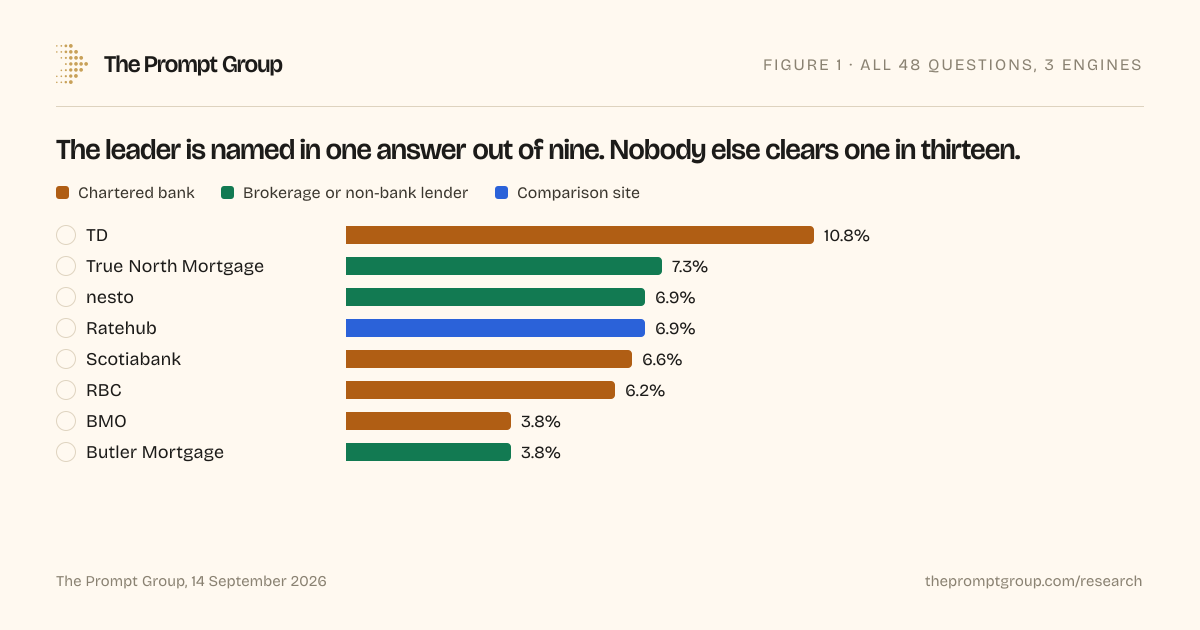
- Nobody owns this category. TD is named in 31 of 288 answers. The next four sit between 6.2 and 7.3 percent, and 130 more companies show up in three answers or fewer each.Figure 1, how often each company is named
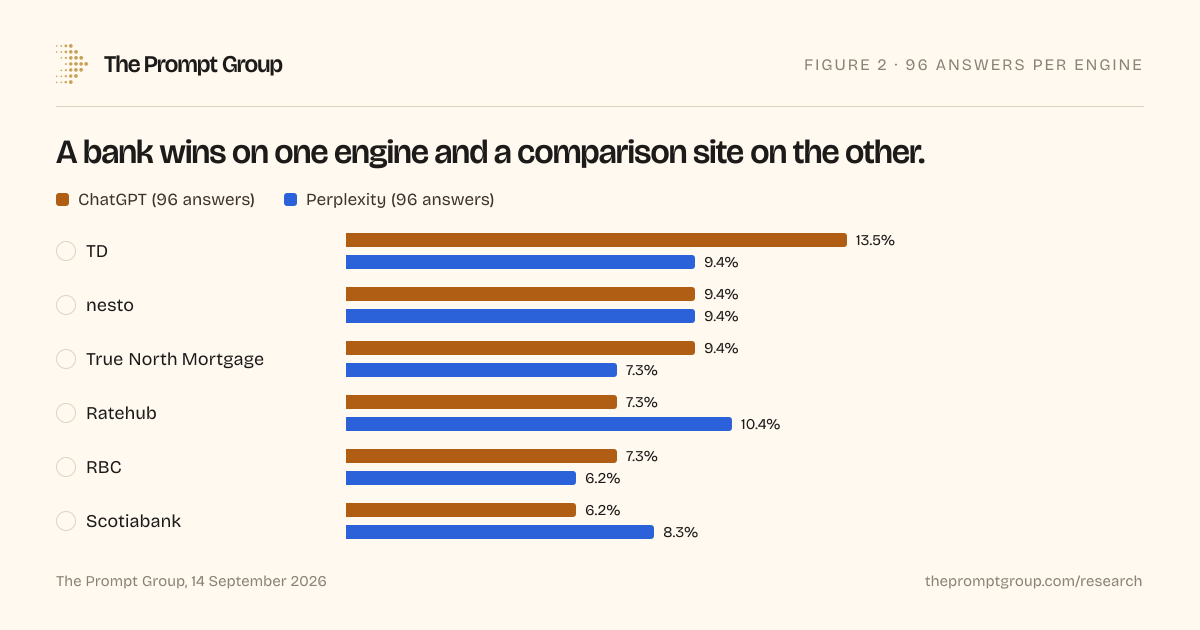
- The engines disagree about who leads. TD tops ChatGPT on 13.5 percent and Google on 9.4. Ratehub tops Perplexity on 10.4 and comes fourth on Google. Same questions, same day.Figure 2, ChatGPT against Perplexity
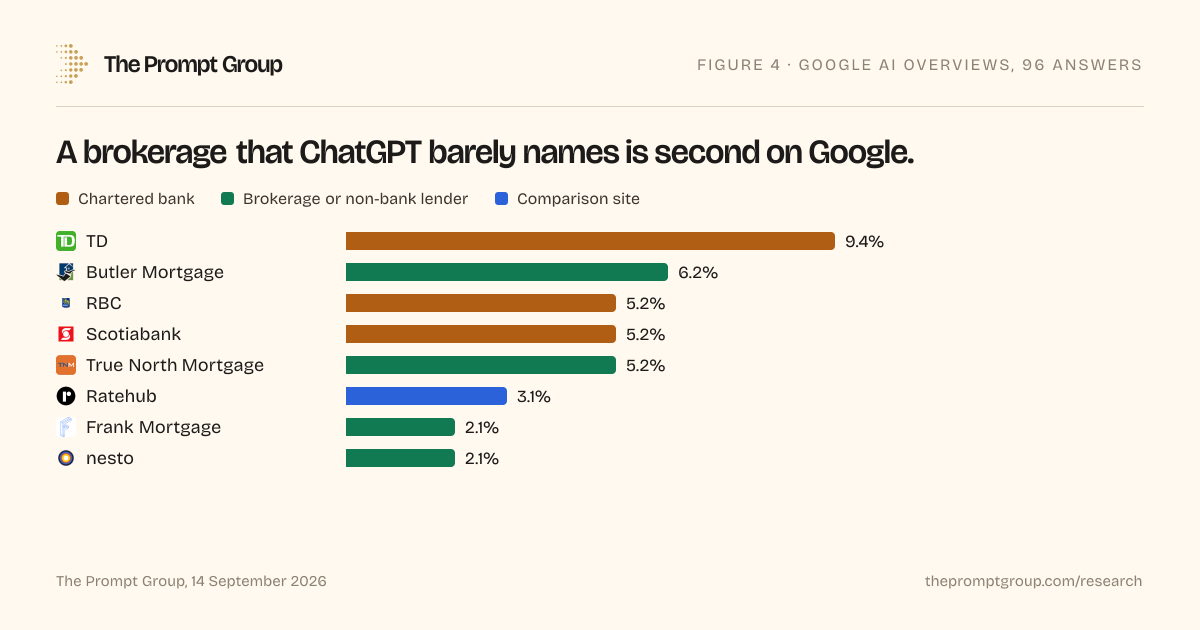
- Google runs its own race. Butler Mortgage is second there on 6.2 percent and does not reach the top thirteen on ChatGPT. nesto drops from second on the other two engines to eighth.Figure 4, the Google AI Overviews shortlist
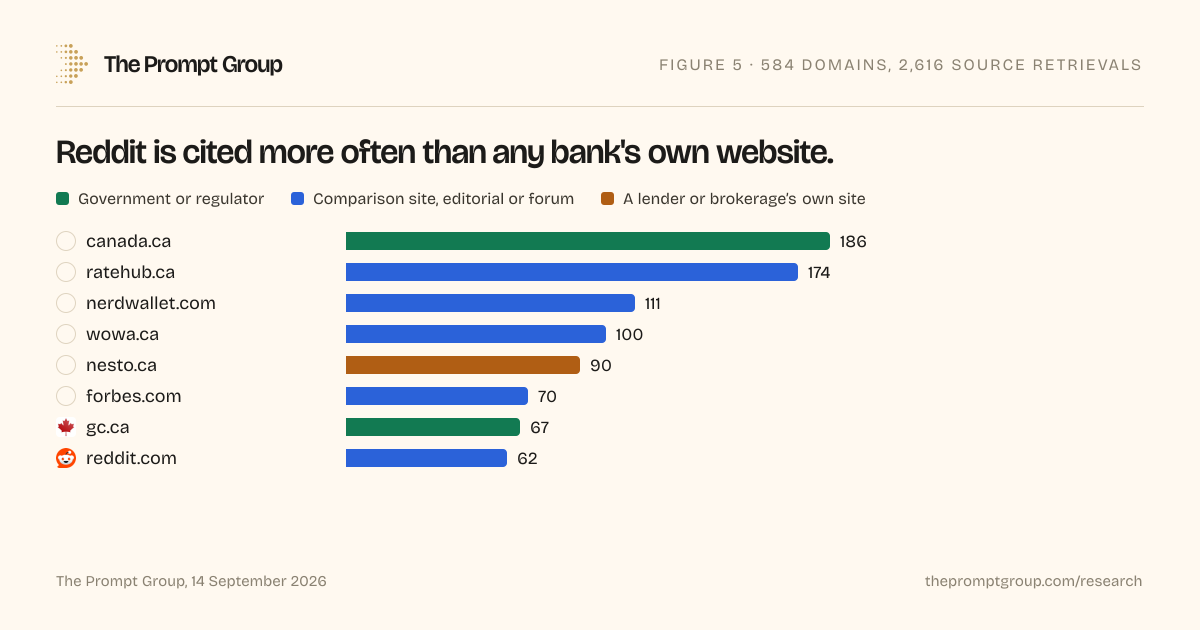
- canada.ca is cited more than any company site. Ratehub is second and NerdWallet Canada third. Reddit beats every bank.Figure 5, the domains AI reads
Why these 48 questions
They are what a Canadian types on the way to a mortgage, and not one of them names a company. Every company in this report was picked by the engine, not prompted by us.
Forty-eight questions, two branded ones set aside, eight topics: rates, broker services, eligibility, the application, pre-approval, refinancing, renewal, and terms and fees. Everything was run from Canadian locations.
Forty-six of the 48 are geographically plain. One names Toronto and one asks about variation by province. That turned out to matter. Several engines localised answers to cities nobody had mentioned, and picked a different city each time they did.
Every question was asked twice, five minutes apart. We did that expecting stability and did not get it. Two runs of the same question often came back with a different set of companies, which is why nothing in this report is described as a trend.
Who gets named, and how rarely
TD, in 31 of 288 answers. Then True North Mortgage on 21, nesto and Ratehub on 20, Scotiabank on 19 and RBC on 18. Nobody else reaches 12.
The drop after the top six is sharp. Seventh and eighth get 11 answers each, twelfth gets 7, and the 130 companies past the top twenty-five turn up three times or fewer. Ask twice and you get a different field.
That tail is the honest picture of this market. Alongside the banks the engines named Clover Mortgage, Canadalend, Cannect, Mortgageville, Sunlite Mortgage, Stonefield Mortgage, Turkin Mortgage, Homewise, 8Twelve and dozens more one-office brokerages. A broker with a good local profile shows up about as often as a monoline with a multi-billion dollar book.
Two of the 48 questions favour True North Mortgage and both are disclosed here rather than quietly dropped. One names Toronto, contrary to the geographic design of the panel, and returned the brand in five of its six responses. One carries a True North Mortgage product name and returned it in three of six. Those two supply eight of the twenty-one answers behind its 7.3 percent. Across the other 46 questions the brand appears in 13 of 276 responses, or 4.7 percent, which would place it seventh rather than second. 4.7 is the figure to quote. Both questions stay in the panel so the instrument stays frozen for the next edition.
Consumer categories do not look like this. Two brands routinely take six of every ten mentions. Here, 155 companies compete for the same shortlist slot and the leader holds it in one answer out of nine.
Three engines, three different shortlists
ChatGPT puts TD first. Perplexity puts Ratehub first. Google puts TD first and Butler Mortgage second, and Butler does not reach ChatGPT's top thirteen at all.
The four names near the top of ChatGPT and Perplexity are the same four in a different order, which is easy to shrug off until you notice a bank leads one and a rate comparison site leads the other. Those are not the same kind of answer. One sends a borrower to a branch. The other sends them to a table of everybody else.
If you are watching a single engine, you are watching a third of a market that disagrees with itself. Averaging the three into one score is worse, because it hides exactly the part you could act on.
Figure 2 · 96 answers per engine
A bank wins on one engine and a comparison site on the other.
- TDChatGPT (96 answers)13.5%Perplexity (96 answers)9.4%
- nestoChatGPT (96 answers)9.4%Perplexity (96 answers)9.4%
- True North MortgageChatGPT (96 answers)9.4%Perplexity (96 answers)7.3%
- RatehubChatGPT (96 answers)7.3%Perplexity (96 answers)10.4%
- RBCChatGPT (96 answers)7.3%Perplexity (96 answers)6.2%
- ScotiabankChatGPT (96 answers)6.2%Perplexity (96 answers)8.3%
- BMOChatGPT (96 answers)4.2%Perplexity (96 answers)7.3%
Data behind Figure 2
| Name | ChatGPT (96 answers) | Perplexity (96 answers) |
|---|---|---|
| TD | 13.5% | 9.4% |
| nesto | 9.4% | 9.4% |
| True North Mortgage | 9.4% | 7.3% |
| Ratehub | 7.3% | 10.4% |
| RBC | 7.3% | 6.2% |
| Scotiabank | 6.2% | 8.3% |
| BMO | 4.2% | 7.3% |
Butler Mortgage is the case worth staring at. Second in the country on Google AI Overviews, outside the top thirteen on ChatGPT, and nothing about the company changed in between. What changed is which pages each engine went and read.
How much each engine actually says
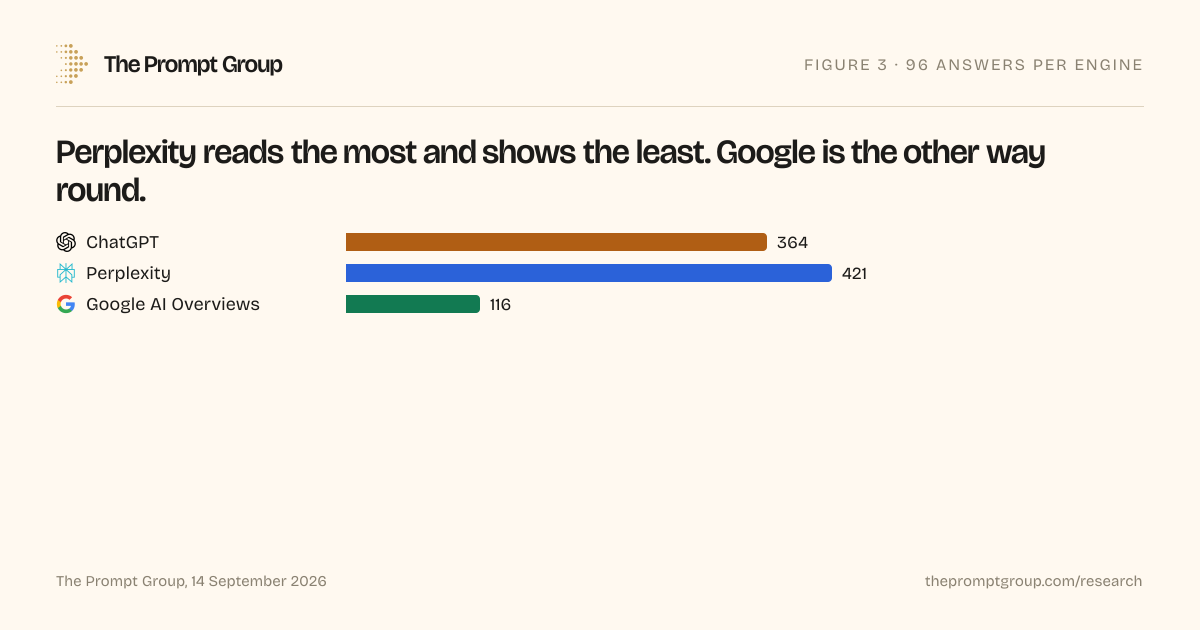
Perplexity names the most companies and shows the fewest sources. Google names the fewest and shows the most. ChatGPT sits between them.
Perplexity pulled 1,400 pages while composing its 96 answers and surfaced 26 clickable citations. Google pulled 369 and surfaced 350. Some of that gap is how each platform reports itself rather than how the model works, so we would not build an argument on the exact ratio. The direction is still striking: the engine that reads least is the one that shows its work.
Figure 3 · 96 answers per engine
Perplexity reads the most and shows the least. Google is the other way round.
- 01ChatGPT364
- 02Perplexity421
- 03Google AI Overviews116
Data behind Figure 3
| Name | Value |
|---|---|
| ChatGPT | 364 |
| Perplexity | 421 |
| Google AI Overviews | 116 |
Google is the outlier at both ends. Fewest mentions, fewest companies and fewest retrievals, with an empty answer on half the responses we read, but the most visible citations of the three. It retrieves the least and shows its work the most.
Google AI Overviews runs its own race
It answered half the time, named 18 companies in total, and produced a shortlist that looks nothing like the other two. Butler Mortgage is second. nesto is eighth.
Google returned an empty overview on 24 of the 48 responses we read in full. It was blank on both runs for seven questions, including how much down payment you need, what closing costs cover, how to apply online and where to find a broker nearby. We cannot tell a refusal from a non-trigger here. The field is an empty string with no sources attached, and Google does not say which.
When it did answer, it drew on 18 companies across 96 answers. Perplexity used 104. That narrowness is the whole story of this figure: the engine sitting on the largest share of Canadian search has the smallest cast of characters, and being in it is worth more than being in either of the others.
Figure 4 · Google AI Overviews, 96 answers
A brokerage that ChatGPT barely names is second on Google.
- 01TD9.4%
- 02Butler Mortgage6.2%
- 03RBC5.2%
- 04Scotiabank5.2%
- 05True North Mortgage5.2%
- 06Ratehub3.1%
- 07Frank Mortgage2.1%
- 08nesto2.1%
- 09Calvert Home Mortgage1.0%
- 10Equitable Bank1.0%
- 11Home Trust1.0%
Data behind Figure 4
| Name | Value | Answers naming it | Share of voice |
|---|---|---|---|
| TD | 9.4% | 9 of 96 | 19.1% |
| Butler Mortgage | 6.2% | 6 of 96 | 12.8% |
| RBC | 5.2% | 5 of 96 | 10.6% |
| Scotiabank | 5.2% | 5 of 96 | 10.6% |
| True North Mortgage | 5.2% | 5 of 96 | 10.6% |
| Ratehub | 3.1% | 3 of 96 | 6.4% |
| Frank Mortgage | 2.1% | 2 of 96 | 4.3% |
| nesto | 2.1% | 2 of 96 | 4.3% |
| Calvert Home Mortgage | 1.0% | 1 of 96 | 2.1% |
| Equitable Bank | 1.0% | 1 of 96 | 2.1% |
| Home Trust | 1.0% | 1 of 96 | 2.1% |
Two brokerages sit in Google's top five and one of them, Frank Mortgage, is a small operation that does not appear in ChatGPT's top thirteen or Perplexity's. Whatever Google is reading on mortgage questions, it is not the same shelf the other two are reading.
What AI reads before it answers you
Government pages first, comparison sites second. canada.ca is the most cited domain in the study and the highest lender-owned site is fifth.
Ratehub, WOWA, NerdWallet Canada and Forbes Advisor Canada sit between every lender in this country and the answer a borrower gets, and canada.ca sits above all of them. Being in a publisher's table is a distribution channel right now, and a more dependable one than your own site.
Page count does as much work as any single page. Ratehub is used across 68 separate pages here and canada.ca across 71. One good page will not get you into this table.
Figure 5 · 584 domains, 2,616 source retrievals
Reddit is cited more often than any bank's own website.
- 01canada.caGOVERNMENT186
- 02ratehub.caCOMPARISON174
- 03nerdwallet.comEDITORIAL111
- 04wowa.caEDITORIAL100
- 05nesto.caLENDER90
- 06forbes.comEDITORIAL70
- 07gc.caGOVERNMENT67
- 08reddit.comFORUM62
- 09rbcroyalbank.comBANK52
- 10truenorthmortgage.caBROKERAGE49
- 11scotiabank.comBANK47
- 12td.comBANK45
- 13mortgagesquad.caBROKERAGE44
- 14rates.caCOMPARISON44
- 15wealthnorth.caEDITORIAL32


Data behind Figure 5
| Domain | Value | Responses using it | Pages used |
|---|---|---|---|
| canada.ca | 186 | 23.0% | 71 |
| ratehub.ca | 174 | 36.5% | 68 |
| nerdwallet.com | 111 | 33.9% | 59 |
| wowa.ca | 100 | 28.3% | 47 |
| nesto.ca | 90 | 25.7% | 47 |
| forbes.com | 70 | 17.4% | 42 |
| gc.ca | 67 | 9.1% | 49 |
| reddit.com | 62 | 20.0% | 47 |
| rbcroyalbank.com | 52 | 18.3% | 21 |
| truenorthmortgage.ca | 49 | 17.0% | 27 |
| scotiabank.com | 47 | 13.9% | 20 |
| td.com | 45 | 15.2% | 24 |
| mortgagesquad.ca | 44 | 16.5% | 33 |
| rates.ca | 44 | 15.7% | 28 |
| wealthnorth.ca | 32 | 11.3% | 24 |
Reddit was used in 46 of the 288 answers, one in six. The threads the engines pulled are ordinary: how long approval takes, broker or bank, what switching at renewal costs.
There is a second thing in the source list. Bankrate, Rocket Mortgage, Chase, Experian, PNC, consumerfinance.gov, LendingTree and MoneySuperMarket all show up, and all of them describe a mortgage market that is not ours. It shows in the answers.
What a lender or brokerage should do with this
One visibility score is not enough to act on. TD tops ChatGPT on 13.5 and Google on 9.4. Ratehub tops Perplexity on 10.4 and sits sixth on Google. Butler Mortgage is second on one engine and nowhere on another. Roll those into a single number and you have hidden the only part you could do something about.
The gap between answer share and market share is the opening. TD leads this study on 10.8 percent while writing far more than a tenth of Canada's mortgages. What the leaderboard measures is who has been legible to a language model. That is a much cheaper thing to fix than market share.
Being read and being named are two different problems. On several questions an engine opened a brokerage's own page, used it, and then pointed the reader at a bank. Across 72 advice answers that brokerage's pages were read seven times and its name appeared in none of them. We cannot prove from one case that thorough content costs you the mention, but it is the obvious thing to test: put the company inside the claim rather than underneath it.
Nobody has claimed the broker questions. Every engine tells people to use a mortgage broker. Six brokerages clear five answers out of 288, and the top one only gets there on two flawed questions. Asked how rates differ between banks and brokers, all six answers explained the difference and none named a broker you could call. That surface is sitting empty on top of real purchase intent.
How we ran it
- Panel
- 50 tracked questions written to match what a Canadian borrower types on the way to a decision. The 48 that name no company are the panel here. The other two are set aside.
- Topics
- Rates 15 questions, broker services 12, terms and fees 8, eligibility 7, the application 6, pre-approval 4, refinancing 4, renewal 2. Questions can carry more than one topic, so those do not add to 48. Topic names were set when the panel was loaded, before any results came back.
- Geography
- Run from Canadian locations with the country set to Canada. Forty-six questions are geographically plain, one names Toronto, one asks about variation by province. None names another country.
- Engines
- ChatGPT, Google AI Overviews and Perplexity.
- Collection
- Two runs on 14 September 2026, about five minutes apart. 48 questions across three engines, twice, is 288 answers, 96 per engine.
- What answer share means
- The percentage of those 288 answers in which a company was named. Not market share, not funded volume, not revenue.
- What we read
- Twenty-four of the 48 questions were read answer by answer, 144 in total, picked to cover every topic and both ends of the intent range. Everything in this report about how the models behave comes from that reading rather than from a dashboard.
- How companies were counted
- The tracking project is built around one Canadian brokerage's domain and counts against a roster. A company outside that roster is not counted no matter how often it is named. 155 matched here, so the real number of distinct companies is higher.
- Sentiment
- A classifier score out of 100, not a measurement of reputation. We report it for context and flag it as unstable under Figure 1.
- Frozen extract
- The project has kept collecting since. Re-run these queries today and you will get a wider window and different numbers. Everything here is the 14 September two-run population, available on request.
- Limitations
- One day, two runs, so nothing here is a trend. Two runs is enough to show that the engines are unstable and not enough to say how unstable. Two of the 48 questions are flawed and both favour True North Mortgage, the brand the tracking project is built around: one names a city when the panel was meant to be geographically plain, and one carries a product name. Both are described under Figure 1 and the corrected 4.7 percent is what we quote. Mortgages.ca is withheld because the instrument matched its name against the word “mortgages” in answers that never mentioned the company. The platform truncates answer text at 2,000 characters, so what an answer contained is solid and what an answer left out is scoped to the questions we read in full. Where Google returned nothing we see an empty string, which could be a refusal or a non-trigger. No rate here was checked against a lender, so where we say the engines disagree about a rate we mean exactly that and nothing about anyone's pricing. And we left out every survey statistic the engines quoted, because one of them cited the same 72 percent figure against two different metrics and two different years inside five minutes.
Cite this report
Sopov, A. (2026). Canada's mortgage answer gap: which lenders and brokers does AI actually name? The Prompt Group Research. https://thepromptgroup.com/research/canadian-mortgage-ai-visibility-2026
Figures and data are free to reuse with attribution under CC BY 4.0. Every chart is available as a PNG carrying its source line, and every dataset as CSV and JSON.
Things people ask us about this study
Which mortgage company does AI recommend in Canada?
No single one, and that is the finding. TD came up most often, in 31 of 288 answers. True North Mortgage was in 21, nesto and Ratehub in 20 each. ChatGPT and Google put TD first. Perplexity put Ratehub first.
Is this market share?
No. It is how often a company got named in a set of AI answers on one day. It says nothing about who is actually writing mortgages.
Why only 48 questions?
Because each one runs on three engines twice, and half of them were read by a person, answer by answer. A bigger panel would have meant nobody reading anything. The panel is frozen so the next edition measures the same thing.
Do the engines get Canadian mortgage rules right?
Mostly, on the parts they mention. The post-2024 insured mortgage rules, the sliding down payment scale, CMHC's minimum credit score and how prepayment penalties work were all correct where they came up, and nothing used an American credit score range. Then there were the answers that described another country entirely. One offered a Canadian buyer VA and USDA loans and private mortgage insurance. One answered a question about Canadian brokers with three British banks. And nothing we read explained the stress test.
Why do the rates in the answers disagree?
Because the engines disagree with each other. Asked for the best five-year fixed available in Canada on one day, the answers ranged from 3.69 to 4.89 percent, and one lender was quoted at three different rates inside an hour. We did not check any of them against a lender's published rate, so treat this as a finding about the answers and not about anyone's pricing.
Why did Google AI Overviews do so badly?
It returned nothing on half the answers we read, and when it did answer it drew on 18 companies. It also produced more clickable citations than either other engine, so it is not simply weaker. Whether the narrowness is caution on money questions or just how overviews trigger is not something this data can tell you.
You built this on True North Mortgage. Does that skew it?
Yes, in two ways, and both are on the page. The company roster the study counts against is built around that brand, and two of the 48 questions favour it. Its corrected number is 4.7 percent rather than 7.3, which moves it from second to seventh, and that is the number we use. It is not a client and had no involvement.
Will a higher score win me business?
We do not know and neither does anyone else selling you this. What it measures is whether you are in the room when the question gets asked.
Are you running this again?
The panel is frozen and the method repeats, so yes at some point. We are not promising a schedule.

Written by
Anton Sopov
Founder, The Prompt Group
Anton Sopov is the founder of The Prompt Group, an AI brand strategy and agentic discovery firm. He works with brands on how they are ranked, cited and described in ChatGPT, Claude, Gemini and Perplexity answers, and is the author of The Delegation Curve.