
 ChatGPT
 Perplexity
 Google AI Overview


What do AI answers say about Canadian cybersecurity providers?
No provider owns the category: CrowdStrike leads on 11.7 percent of provider mentions, and the two engines that name providers at all rank the leaders in almost opposite order.
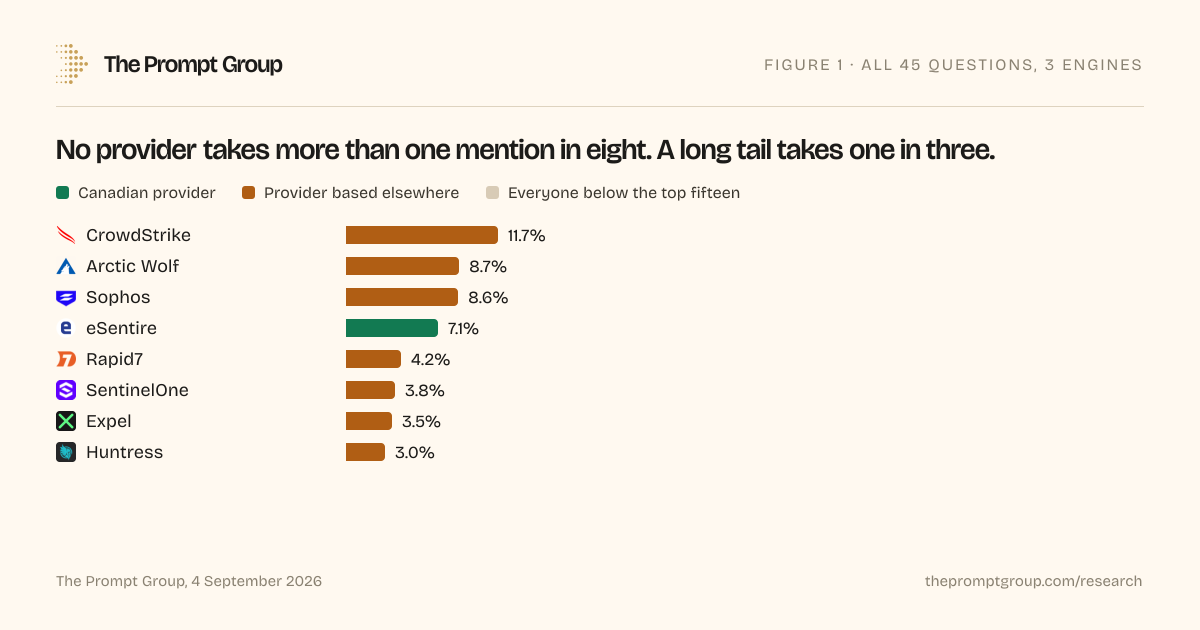
No provider took more than 11.7 percent of 1,991 provider mentions in 405 Canadian cybersecurity answers, and 161 providers split 35.6 percent.
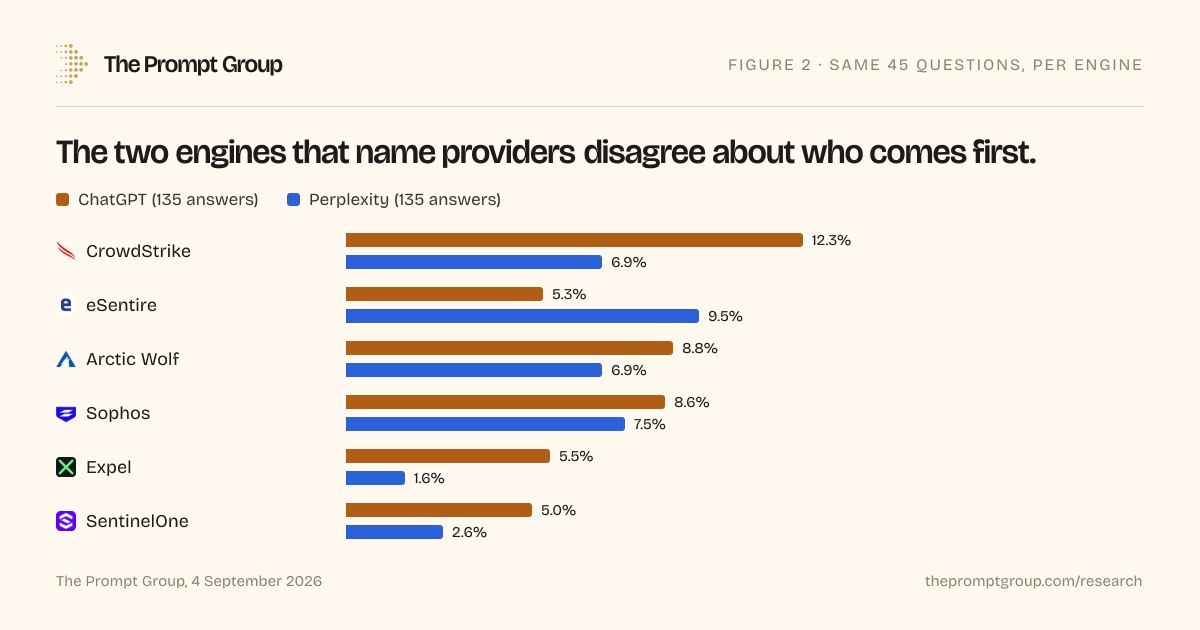
Figure 1ChatGPT and Perplexity invert the leading set: CrowdStrike takes 12.3 percent on ChatGPT and 6.9 on Perplexity, eSentire 5.3 and 9.5.
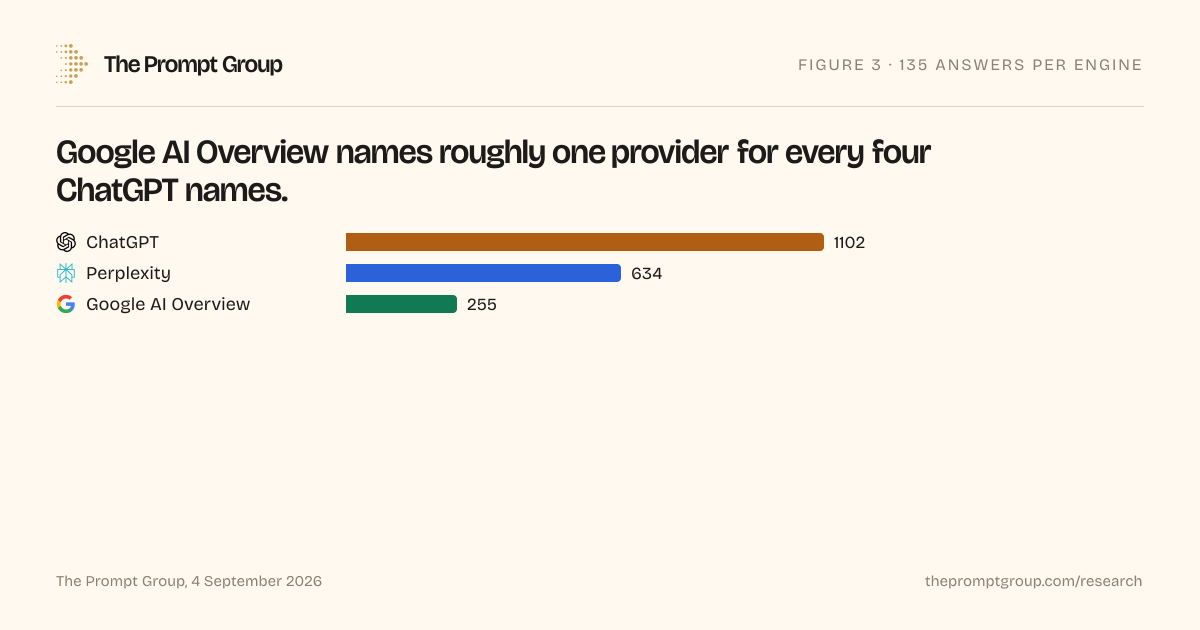
Figure 2ChatGPT produced 1,102 provider mentions across 111 providers; Google AI Overview produced 255 across 37.
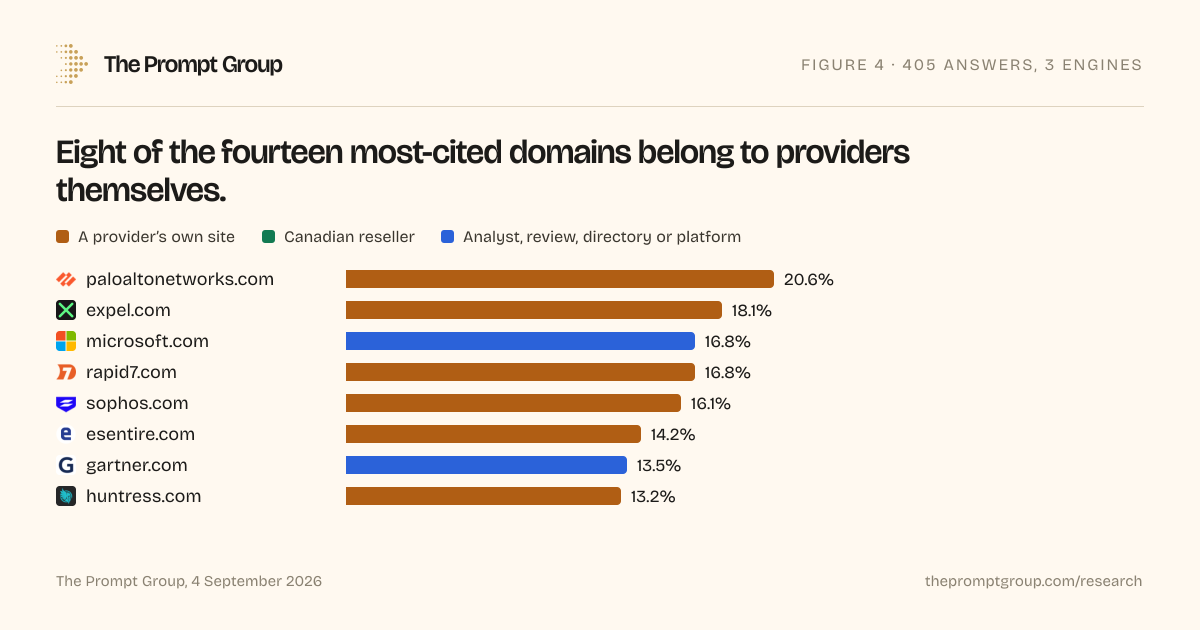
Figure 3Eight of the fourteen most cited domains are provider-owned sites, led by paloaltonetworks.com at 20.6 percent of answers.
Figure 4microsoft.com needs 126 cited pages to reach 16.8 percent of answers; kaseya.com reaches 11.3 percent from nine.
Figure 4
Which cybersecurity questions did we ask AI?
Forty-five unbranded questions across eight topics, weighted towards managed detection and response.
The panel comprises 45 conversational prompts a Canadian security buyer would put to an assistant on the way to a shortlist. They are distributed across eight topics: managed detection and response (24 questions), vendor evaluation (9), implementation and onboarding (7), incident response (7), threat hunting (6), security operations (5), compliance reporting (4) and security assessment (4). Questions can carry more than one topic, so the counts exceed 45.
Each question went to ChatGPT, Perplexity and Google AI Overview three times on 4 and 5 September 2026 from a Canadian location, producing 405 answers. We read every one for the providers it named and the pages it cited.
This is a detection and response panel rather than a survey of every security budget line, so read the shares as the shortlist stage of that decision. Five questions in the tracked set name a provider and are excluded from every figure here.
A panel containing branded questions inflates whichever providers those questions name, so every share reported here reflects a provider the engine volunteered.
Which cybersecurity providers does AI name most in Canada?
CrowdStrike, on 11.7 percent of provider mentions, followed by Arctic Wolf at 8.7, Sophos at 8.6 and eSentire at 7.1.
Visibility concentrates in a small group and then disperses. The four leading providers take 36.1 percent of 1,991 mentions between them and the fifteen most named take 64.4 percent, while the remaining 161 providers split 35.6 percent without one of them reaching 1.4. The tenth provider takes 2.5 percent and the fifteenth 1.4.
Four of the fifteen are Canadian: eSentire, CDW Canada, CIRA MDR and EY Canada. They sit among the global platforms rather than in a bracket of their own, because the answers offer them as alternatives to one another.
The full ranking
No provider takes more than one mention in eight. A long tail takes one in three.
- 01CrowdStrike11.7%
- 02Arctic Wolf8.7%
- 03Sophos8.6%
- 04eSentire7.1%
- 05Rapid74.2%
- 06SentinelOne3.8%
- 07Expel3.5%
- 08Huntress3.0%
- 09Red Canary2.6%
- 10Palo Alto Networks2.5%
- 11CDW Canada2.1%
- 12CIRA MDR1.9%
- 13EY Canada1.9%
- 14ESET1.4%
- 15Secureworks1.4%
- 161 other providers35.6%
Data behind Figure 1
Share of provider mentions across the 405 answers to unbranded questions, pooled over three runs. The Prompt Group, 4 September 2026.
Providers are extracted automatically, so resellers and consultancies count alongside product vendors, because the answers offer them as alternatives to one another. A ring means the grouped remainder, or a site we could not confirm.
| Name | Value | Answers naming it | Average position | Sentiment |
|---|---|---|---|---|
| CrowdStrike | 11.7% | 24.2% | 2.9 | 68 / 100 |
| Arctic Wolf | 8.7% | 18% | 2.7 | 69 / 100 |
| Sophos | 8.6% | 17.8% | 2.7 | 71 / 100 |
| eSentire | 7.1% | 14.8% | 2.3 | 76 / 100 |
| Rapid7 | 4.2% | 8.6% | 4.1 | 69 / 100 |
| SentinelOne | 3.8% | 7.9% | 3.5 | 61 / 100 |
| Expel | 3.5% | 7.2% | 3.0 | 72 / 100 |
| Huntress | 3.0% | 6.2% | 2.8 | 70 / 100 |
| Red Canary | 2.6% | 5.4% | 4.2 | 74 / 100 |
| Palo Alto Networks | 2.5% | 5.2% | 3.5 | 56 / 100 |
| CDW Canada | 2.1% | 4.4% | 3.3 | 59 / 100 |
| CIRA MDR | 1.9% | 4% | 3.6 | 74 / 100 |
| EY Canada | 1.9% | 4% | 7.0 | 70 / 100 |
| ESET | 1.4% | 3% | 2.7 | 81 / 100 |
| Secureworks | 1.4% | 3% | 5.5 | 61 / 100 |
| 161 other providers | 35.6% | under 3% each |
A field of 176 providers competing for one shortlist slot is unusually open, and 64.4 percent held by fifteen companies is low for a category with this many established vendors. A provider outside the top four is competing against a long tail rather than a dominant incumbent.
Providers are extracted automatically, so resellers and consultancies are counted alongside product vendors, because the answers present them as alternatives.
Does ChatGPT recommend the same cybersecurity providers as Perplexity?
No. The two engines name the same leading set and invert it: CrowdStrike takes 12.3 percent on ChatGPT and 6.9 on Perplexity.
The reversal runs through the set rather than one company. eSentire takes 5.3 percent on ChatGPT and 9.5 on Perplexity. Expel and SentinelOne are the clearest ChatGPT specialists at 5.5 and 5.0 against 1.6 and 2.6, and EY Canada runs the other way at 0.8 against 4.2, the largest proportional swing in the set at more than five to one.
These are shares of each engine's own 135 answers, so the two columns are comparable to each other and not to the pooled figure.
Engine by engine
The two engines that name providers disagree about who comes first.
- 01CrowdStrike12.3%6.9%
- 02eSentire5.3%9.5%
- 03Arctic Wolf8.8%6.9%
- 04Sophos8.6%7.5%
- 05Expel5.5%1.6%
- 06SentinelOne5.0%2.6%
- 07Rapid74.0%2.9%
- 08EY Canada0.8%4.2%
Data behind Figure 2
Share of provider mentions within each engine's own 135 answers, for the eight providers reaching 4 percent in either. The Prompt Group, 4 September 2026.
| Name | ChatGPT (135 answers) | Perplexity (135 answers) |
|---|---|---|
| CrowdStrike | 12.3% | 6.9% |
| eSentire | 5.3% | 9.5% |
| Arctic Wolf | 8.8% | 6.9% |
| Sophos | 8.6% | 7.5% |
| Expel | 5.5% | 1.6% |
| SentinelOne | 5.0% | 2.6% |
| Rapid7 | 4.0% | 2.9% |
| EY Canada | 0.8% | 4.2% |
The two engines read different material to get there. ChatGPT leans on vendor documentation and comparison pages, while Perplexity cites more resellers, consultancies and Canadian sites, which is where CDW Canada and EY Canada pick up their positions.
Work that lifts a provider on one engine will not necessarily move the other, so a single blended visibility score removes the variation a provider could act on.
Which AI engines name cybersecurity vendors at all?
ChatGPT most, with 1,102 provider mentions across 135 answers, against 634 for Perplexity and 255 for Google AI Overview.
The engines differ in breadth as well as volume. ChatGPT covered 111 distinct providers, Perplexity 96 and Google AI Overview 37, which works out at 8.2, 4.7 and 1.9 mentions per answer.
Google AI Overview is also the least stable of the three. It named almost nobody in the first two runs and named providers freely in the third, which is where most of its 255 mentions come from.
How much each engine names
Google AI Overview names roughly one provider for every four ChatGPT names.
- 1102ChatGPT
- 634Perplexity
- 255Google AI Overview
Data behind Figure 3
Provider mentions in each engine's own 135 answers, and how many distinct providers they covered. The Prompt Group, 4 September 2026.
Google AI Overview was near silent in the first two runs and far more forthcoming in the third, which is where most of its total comes from.
| Name | Value | Providers named | Answers |
|---|---|---|---|
| ChatGPT | 1102 | 111 | 90 |
| Perplexity | 634 | 96 | 90 |
| Google AI Overview | 255 | 37 | 90 |
ChatGPT is the engine where an absence costs most, because 110 other providers were named in its answers and a buyer reading it sees the widest field.
Google AI Overview quadrupled between runs on the same questions, so its level is not a stable target. We report it and would not set a goal against it until a later edition shows whether the third run or the first two is typical.
Which sources do AI answers cite about Canadian cybersecurity?
Provider-owned sites. Eight of the fourteen most cited domains belong to providers, led by paloaltonetworks.com at 20.6 percent of answers.
The 405 answers carried 4,742 citations across 876 domains. Eight of the fourteen most cited are provider sites, and the pages cited are topic guides, comparisons and ranked lists rather than campaign pages. Analyst, review and directory sources fill most of the rest: gartner.com at 13.5 percent, g2.com at 11.6, and mdrproviders.io, a directory nobody in the category owns, at 11.9.
These shares are the proportion of the 405 answers citing at least one page on the domain, so they overlap and do not sum.
Most cited domains
Eight of the fourteen most-cited domains belong to providers themselves.
- 01paloaltonetworks.comPROVIDER20.6%
- 02expel.comPROVIDER18.1%
- 03microsoft.comPLATFORM16.8%
- 04rapid7.comPROVIDER16.8%
- 05sophos.comPROVIDER16.1%
- 06esentire.comPROVIDER14.2%
- 07gartner.comANALYST13.5%
- 08huntress.comPROVIDER13.2%
- 09underdefense.comPROVIDER12.9%
- 10cdw.caRESELLER12.6%
- 11expertinsights.comEDITORIAL11.9%
- 12mdrproviders.ioDIRECTORY11.9%
- 13g2.comREVIEW11.6%
- 14kaseya.comPROVIDER11.3%


Data behind Figure 4
Share of the 405 answers citing at least one page on the domain. The Prompt Group, 4 September 2026.
Type is our own classification, and the measurement treats every provider site the same way, so all of them read as a provider site here.
| Domain | Value | Citations | Pages cited |
|---|---|---|---|
| paloaltonetworks.com | 20.6% | 104 | 50 |
| expel.com | 18.1% | 109 | 49 |
| microsoft.com | 16.8% | 173 | 126 |
| rapid7.com | 16.8% | 100 | 49 |
| sophos.com | 16.1% | 79 | 38 |
| esentire.com | 14.2% | 81 | 47 |
| gartner.com | 13.5% | 75 | 37 |
| huntress.com | 13.2% | 66 | 23 |
| underdefense.com | 12.9% | 58 | 30 |
| cdw.ca | 12.6% | 49 | 19 |
| expertinsights.com | 11.9% | 49 | 13 |
| mdrproviders.io | 11.9% | 68 | 40 |
| g2.com | 11.6% | 62 | 30 |
| kaseya.com | 11.3% | 37 | 9 |
Authority concentrates in pages rather than domains. microsoft.com needs 126 separate cited pages to reach 16.8 percent of answers, while kaseya.com reaches 11.3 percent from nine and expertinsights.com 11.9 from thirteen.
That suggests a small number of aimed pages can do the work of a documentation library, which is the opposite of how most content programmes in this category are budgeted.
What should a Canadian cybersecurity provider do about this?
Measure each engine separately, and put the buying question on a documentation page rather than a campaign page.
Measure each engine as a separate market. CrowdStrike takes 12.3 percent of mentions on ChatGPT and 6.9 on Perplexity, eSentire 5.3 and 9.5, EY Canada 0.8 and 4.2. A single blended score removes the only variation a provider can act on.
Answer the buying question in documentation. Eight of the fourteen most cited domains are provider sites, and the pages cited are topic guides, comparisons and ranked lists. Campaign pages do not appear in the cited set at all.
A small number of aimed pages beats a library. kaseya.com reaches 11.3 percent of the 405 answers from nine cited pages and expertinsights.com 11.9 percent from thirteen, while microsoft.com needs 126 pages to reach 16.8 percent.
The field is open rather than owned. 176 providers were named and the fifteen most named hold 64.4 percent of 1,991 mentions. A provider outside the top four is competing against a long tail rather than a dominant incumbent.
How was this cybersecurity AI visibility study measured?
45 questions that name no provider, put to ChatGPT, Perplexity and Google AI Overview once per engine per run over three runs on 4 and 5 September 2026, giving 405 answers.
What we asked, word for word4 of the panel
- Who are the best managed detection and response providers in Canada
- Which cybersecurity company should I hire for my Canadian business
- What should I look for in an MDR provider
- How much does managed detection and response cost in Canada
- Panel
- 50 tracked questions written to match what a Canadian security buyer types on the way to a shortlist. The 45 that name no company are the panel for this report; the other 5 are excluded.
- What the panel covers
- Eight topics, weighted towards detection and response: managed detection and response 24 questions, vendor evaluation 9, implementation and onboarding 7, incident response 7, threat hunting 6, security operations 5, compliance reporting 4, security assessment 4. Questions can carry more than one topic. The panel does not cover identity, cloud posture, email security or penetration testing pricing, so it describes the detection and response shortlist rather than every security budget line.
- Unbranded filter
- Every figure on this page is drawn from questions that name no provider. A question that names a company will name it back, so mixing branded and unbranded questions inflates whoever the questions mention. Applying the filter moves the numbers: esentire.com falls from the most-cited domain in the full panel to sixth here.
- Collection
- Three runs. Two on 4 September 2026 five minutes apart, and one on 5 September 2026. Each question asked once per engine per run from a Canadian location. 405 unbranded answers in total, 135 per engine.
- Share of provider mentions
- A provider’s mentions divided by all provider mentions in the set being reported. A provider named twice in one answer counts once. Sums to 100 percent within a set.
- Answers naming a provider
- Answers naming the provider at least once, divided by all 405 answers. Two providers can share a share of mentions and differ here.
- Average position and sentiment
- Position is where the provider appears in the list an answer gives, averaged across the answers naming it. Sentiment is scored from the language around each mention on a 0 to 100 scale, where 50 is neutral.
- Answers citing a domain
- Answers containing at least one citation to a page on the domain, divided by all 405 answers.
- Entity extraction
- Providers were identified by automated extraction from each answer. Resellers, consultancies and accounting firms appear alongside product vendors because the answers offer them as alternatives to one another.
- Limitations
- Three runs across two days, and two of those runs were five minutes apart, so this is closer to two collection moments than three. Answer engines vary run to run and this panel shows how much: Google AI Overview named almost nobody in the first two runs and named providers freely in the third, which is where most of its 255 mentions come from. Read the order of providers below 3 percent as unstable. The panel is 45 questions weighted towards detection and response, so it describes that shortlist rather than the whole security market. The unbranded classification is automated; we checked all 50 questions by hand against the flag and found no disagreement, but a larger panel might.
Cite this report
Sopov, A. (2026). The Prompt Group Research. https://thepromptgroup.com/research/cybersecurity-providers/ca
Figures and data are free to reuse with attribution under CC BY 4.0. Every chart is available as a PNG carrying its source line, and every dataset as CSV and JSON.
What do people ask about AI search and Canadian cybersecurity providers?
Which provider each AI engine names in Canada, which sources it cites, and how a provider should measure its visibility, all from the 4 and 5 September 2026 collection.
Which cybersecurity provider does AI recommend in Canada?
No single provider. Across 405 answers to 45 unbranded questions on 4 and 5 September 2026, CrowdStrike took 11.7 percent of 1,991 provider mentions, followed by Arctic Wolf at 8.7, Sophos at 8.6 and eSentire at 7.1. ChatGPT put CrowdStrike first and Perplexity put eSentire first.
Which cybersecurity provider does ChatGPT recommend in Canada?
CrowdStrike. CrowdStrike took 12.3 percent of the provider mentions in ChatGPT's 135 answers on 4 and 5 September 2026, ahead of Arctic Wolf at 8.8, Sophos at 8.6 and Expel at 5.5.
Which cybersecurity provider does Perplexity recommend in Canada?
eSentire. Perplexity gave eSentire 9.5 percent of the provider mentions in its 135 answers on 4 and 5 September 2026, ahead of Sophos at 7.5, while CrowdStrike, first on ChatGPT, was joint third at 6.9.
Does Google AI Overview recommend cybersecurity vendors?
Less than the other engines, and unpredictably. Across 135 answers Google AI Overview produced 255 provider mentions covering 37 providers, against 1,102 mentions and 111 providers from ChatGPT on the same questions. It named almost nobody in the first two collection runs and named providers freely in the third.
What is answer engine optimization (AEO) for a cybersecurity company?
AEO is the work of being named, and described accurately, when a security buyer asks an AI engine instead of a search box. In Canada the engines disagree enough to need measuring separately: CrowdStrike took 12.3 percent of provider mentions on ChatGPT and 6.9 on Perplexity, on the same 45 questions.
Which questions should a cybersecurity provider track in AI search?
Unbranded buying questions, the ones that name no provider, because those decide who gets introduced. Branded questions inflate whoever they name: esentire.com was the most cited domain across our full panel and fell to sixth on the 45 unbranded questions.
Which sources do AI answers cite about Canadian cybersecurity?
Mostly the providers themselves. Eight of the fourteen most cited domains are provider sites, led by paloaltonetworks.com at 20.6 percent of answers. gartner.com and g2.com are the most cited analyst and review sites.
What kind of page gets a cybersecurity provider cited by AI?
Topic guides, comparisons and ranked lists, and not many of them. Campaign pages did not appear in the cited set of 405 Canadian answers, and kaseya.com reached 11.3 percent of answers from nine cited pages while microsoft.com needed 126 to reach 16.8 percent.
How should a cybersecurity provider connect AEO to its brand strategy?
Start from the positioning the provider wants buyers to repeat, then test whether each engine uses it on the questions buyers ask. ChatGPT and Perplexity ranked the same leading providers in almost opposite order, so one blended score can hide a brand that leads on one engine and trails on the other. This study counted mentions and citations, not how each provider was described.
Do Canadian cybersecurity companies get named alongside global vendors?
Yes. Four of the fifteen most named providers are Canadian: eSentire, CDW Canada, CIRA MDR and EY Canada. The answers offer them as alternatives to CrowdStrike and Sophos rather than in a separate bracket.

Written by
Founder, The Prompt Group
Anton Sopov is the founder of The Prompt Group, an AI brand strategy and agentic discovery firm. He works with brands on how they are ranked, cited and described in ChatGPT, Claude, Gemini and Perplexity answers, and is the author of The Delegation Curve.
 Canada
 United States
 United Kingdom
 Australia