
 ChatGPT
 Perplexity
 Google AI Overview


What do AI answers say about Canadian wealth management firms?
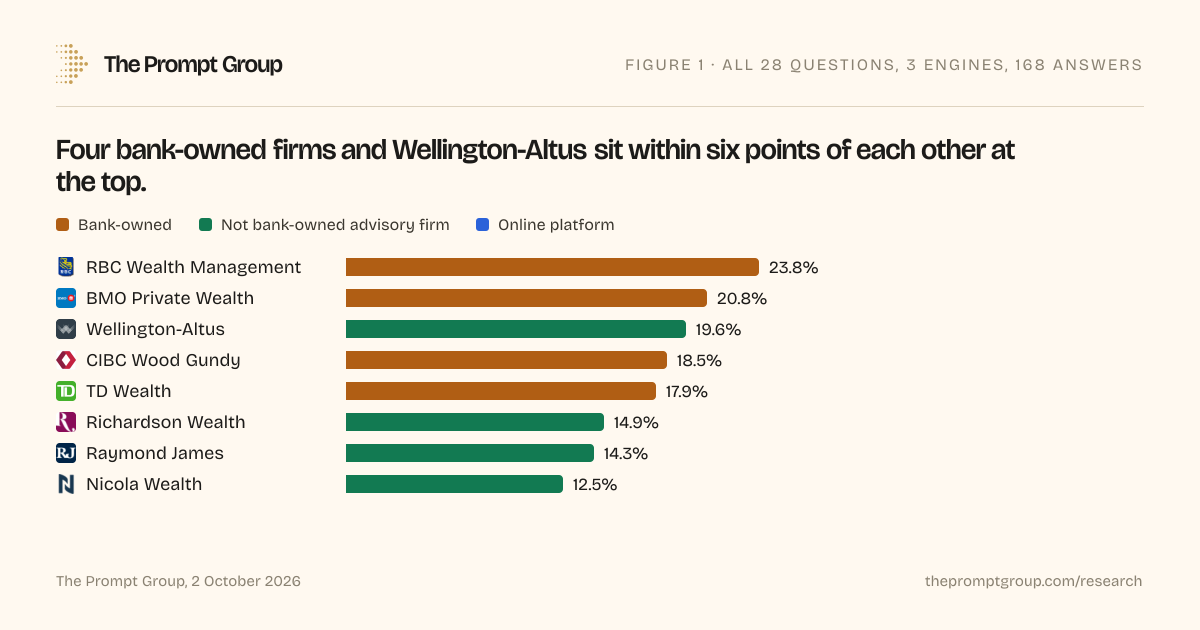
Four bank-owned firms and Wellington-Altus share the top of the field, and the two engines that name firms reliably put different firms first.
RBC Wealth Management was named in 23.8 percent of 168 answers, and the top five firms sit within 5.9 points.
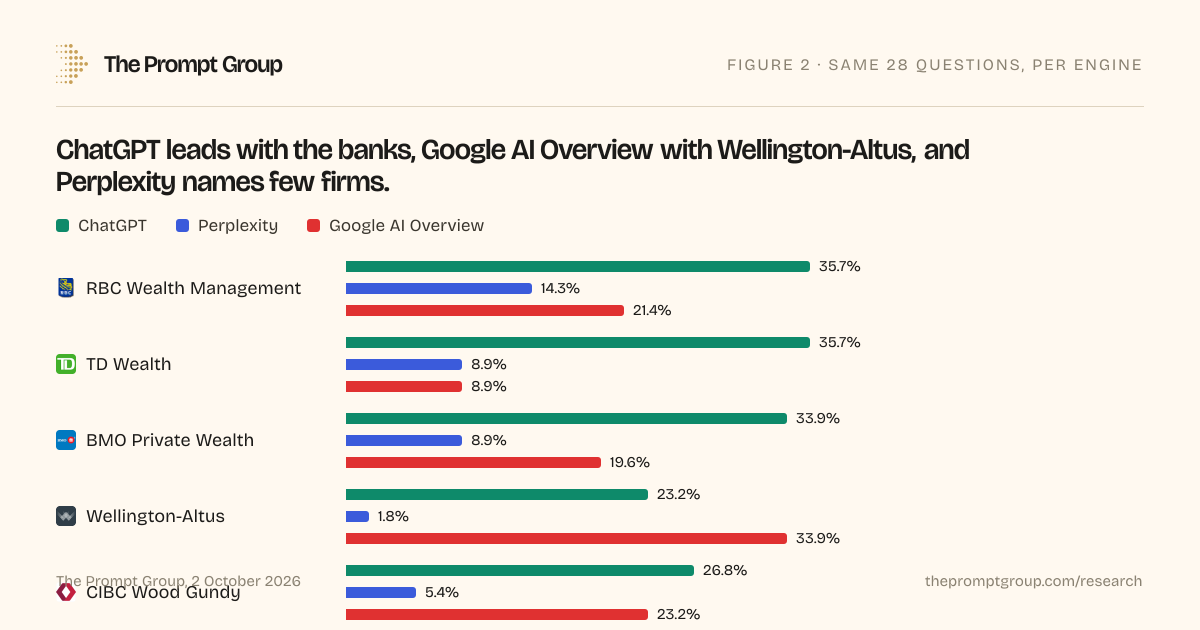
Figure 1On commercial questions, Google AI Overview named Wellington-Altus in 57.1 percent of answers and ChatGPT in 39.3 percent, sixth among firms.
Figure 2TD Wealth was named in 35.7 percent of ChatGPT answers and 8.9 percent of Google AI Overview answers, the widest gap between engines.
Figure 2In 32 of 56 Perplexity answers most cited sources were unrelated to the question, so Perplexity figures here are not a reliable read.
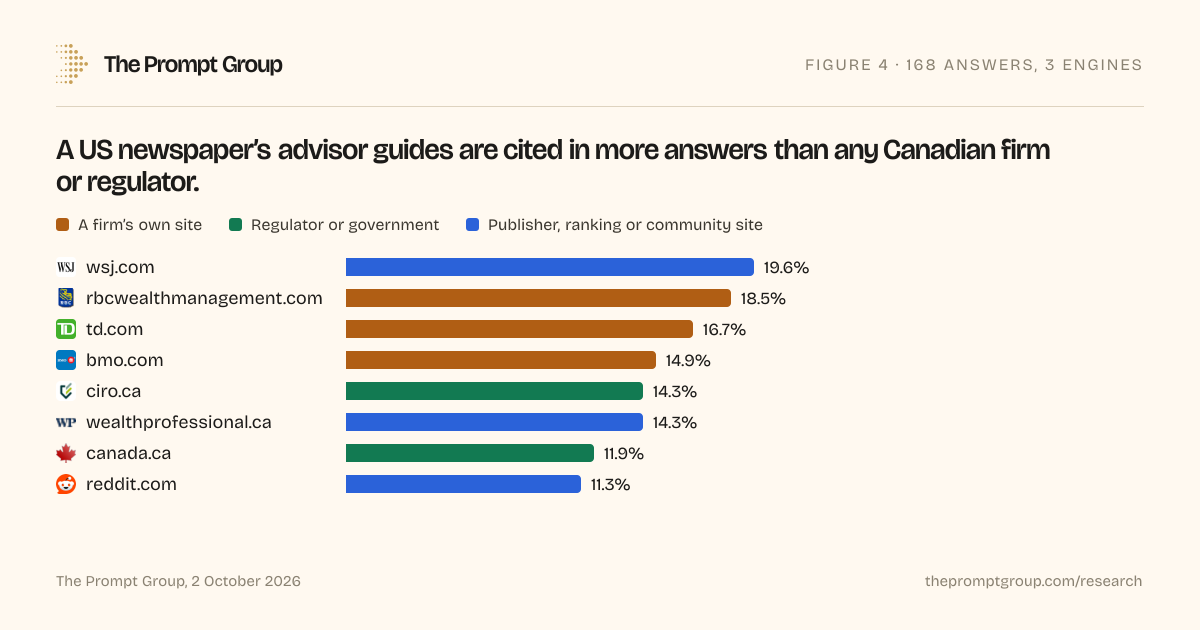
Figure 2wsj.com’s US advisor guides were cited in 33 of 168 Canadian answers, more than any Canadian firm or regulator.
Figure 4Google AI Overview took 18.0 percent of its citations from forums and social media; ChatGPT took 0.1 percent.
Figure 5
Which wealth management questions did we ask AI?
Twenty-eight questions that name no firm. Fourteen are buying questions, and those produce almost every firm the engines name.
The panel is 28 questions a Canadian investor might put to an assistant while choosing a firm. They cover six topics: firm comparison and reputation (9), choosing an advisor (6), high net worth and business owners (6), fees and cost (4), independent against bank (4) and corporate ownership (1). Searchable labels 14 of them commercial, 9 informational and 5 transactional.
Each question went to ChatGPT, Perplexity and Google AI Overview twice on 2 October 2026, giving 168 answers. The tracked set is 36 questions, and we set aside the eight that name a firm, four of them Wellington-Altus.
Intent changes the result more than the choice of engine does. Answers to the 14 commercial questions named a firm 83.3 percent of the time, against 16.7 percent for the 9 informational questions, so visibility in this category sits in a narrow band of shortlist questions.
A firm that measures itself on definitional questions such as how advisors are paid will find almost nothing to measure.
Which wealth management firms does AI name most in Canada?
RBC Wealth Management, in 23.8 percent of 168 answers, then BMO Private Wealth at 20.8, Wellington-Altus at 19.6, CIBC Wood Gundy at 18.5 and TD Wealth at 17.9.
The top five sit within 5.9 points of each other, and four of the five are bank-owned. Below them the field opens: Richardson Wealth, Raymond James and Nicola Wealth sit between 12.5 and 14.9 percent, and the next firm, Wealthsimple, is at 7.1.
The engines named 156 firms in 524 mentions. Ninety-six of them were named once, and the ten most named take 50.0 percent of all mentions, so the category has a crowded head and a long tail of local advisory practices.
The full ranking
Four bank-owned firms and Wellington-Altus sit within six points of each other at the top.
- 01RBC Wealth Management23.8%
- 02BMO Private Wealth20.8%
- 03Wellington-Altus19.6%
- 04CIBC Wood Gundy18.5%
- 05TD Wealth17.9%
- 06Richardson Wealth14.9%
- 07Raymond James14.3%
- 08Nicola Wealth12.5%
- 09Wealthsimple7.1%
- 10Harbourfront Wealth6.5%
- 11Canaccord Genuity6.5%
- 12Questrade6.5%
- 13Assante5.4%
- 14National Bank Financial5.4%
- 15Scotia Wealth Management3.6%
Data behind Figure 1
Share of the 168 answers to unbranded questions that name each firm, pooled over two runs. The Prompt Group, 2 October 2026.
Ownership group is our classification, as of October 2026. Firm names follow the Searchable roster, so TD Wealth stands for TD Wealth Private Investment Advice. A ring means a site whose mark we could not confirm.
| Name | Value | Answers naming it |
|---|---|---|
| RBC Wealth Management | 23.8% | 40 of 168 |
| BMO Private Wealth | 20.8% | 35 of 168 |
| Wellington-Altus | 19.6% | 33 of 168 |
| CIBC Wood Gundy | 18.5% | 31 of 168 |
| TD Wealth | 17.9% | 30 of 168 |
| Richardson Wealth | 14.9% | 25 of 168 |
| Raymond James | 14.3% | 24 of 168 |
| Nicola Wealth | 12.5% | 21 of 168 |
| Wealthsimple | 7.1% | 12 of 168 |
| Harbourfront Wealth | 6.5% | 11 of 168 |
| Canaccord Genuity | 6.5% | 11 of 168 |
| Questrade | 6.5% | 11 of 168 |
| Assante | 5.4% | 9 of 168 |
| National Bank Financial | 5.4% | 9 of 168 |
| Scotia Wealth Management | 3.6% | 6 of 168 |
Wellington-Altus is the only firm in the top five not owned by a bank. Below the top eight, no firm is named in more than one answer in thirteen.
The pooled ranking averages three engines that disagree, and one of them is unreliable in this collection. Read the order inside the top five as a tie, and read Figure 2 before quoting any one engine.
Does ChatGPT name the same wealth management firms as Google AI Overview?
ChatGPT names RBC Wealth Management and TD Wealth most, each in 35.7 percent of its answers, while Google AI Overview names Wellington-Altus most, in 33.9 percent.
On the 14 commercial questions the gap widens. ChatGPT named RBC Wealth Management in 60.7 percent of its 28 answers and Wellington-Altus in 39.3, sixth. Google AI Overview named Wellington-Altus in 57.1 percent and Nicola Wealth in 50.0, with RBC at 28.6.
TD Wealth shows the largest reversal: 35.7 percent on ChatGPT and 8.9 on Google AI Overview. Bank-owned firms take 35.4 percent of firm mentions on ChatGPT against 28.8 on Google AI Overview, under our ownership classification.
Engine by engine
ChatGPT leads with the banks, Google AI Overview with Wellington-Altus, and Perplexity names few firms.
- 01RBC Wealth Management35.7%14.3%21.4%
- 02TD Wealth35.7%8.9%8.9%
- 03BMO Private Wealth33.9%8.9%19.6%
- 04Wellington-Altus23.2%1.8%33.9%
- 05CIBC Wood Gundy26.8%5.4%23.2%
- 06Richardson Wealth26.8%3.6%14.3%
- 07Nicola Wealth10.7%1.8%25.0%
- 08Raymond James12.5%8.9%21.4%
- 09Harbourfront Wealth5.4%1.8%12.5%
- 10Canaccord Genuity8.9%010.7%
- 11National Bank Financial10.7%05.4%
- 12Wealthsimple8.9%3.6%8.9%
- 13Questrade5.4%5.4%8.9%
- 14Assante7.1%1.8%7.1%
- 15Scotia Wealth Management5.4%05.4%
Data behind Figure 2
Share of each engine’s 56 answers that name each firm, pooled over two runs. The Prompt Group, 2 October 2026.
Two of Google AI Overview’s 56 answers came back empty and count as naming nobody. Most Perplexity answers rest on unrelated sources; see the section on Perplexity.
| Name | ChatGPT | Perplexity |
|---|---|---|
| RBC Wealth Management | 35.7% | 14.3% |
| TD Wealth | 35.7% | 8.9% |
| BMO Private Wealth | 33.9% | 8.9% |
| Wellington-Altus | 23.2% | 1.8% |
| CIBC Wood Gundy | 26.8% | 5.4% |
| Richardson Wealth | 26.8% | 3.6% |
| Nicola Wealth | 10.7% | 1.8% |
| Raymond James | 12.5% | 8.9% |
| Harbourfront Wealth | 5.4% | 1.8% |
| Canaccord Genuity | 8.9% | 0 |
| National Bank Financial | 10.7% | 0 |
| Wealthsimple | 8.9% | 3.6% |
| Questrade | 5.4% | 5.4% |
| Assante | 7.1% | 1.8% |
| Scotia Wealth Management | 5.4% | 0 |
The two engines appear to answer the same buying question from different evidence. ChatGPT’s shortlists lead with the bank-owned dealers and ChatGPT cites the bank sites far more often than Google AI Overview does (Figure 4), while Google AI Overview gives more room to independent firms.
Wellington-Altus is first on Google AI Overview and sixth on ChatGPT for the same commercial questions, so a blended score would hide the engine where it has the most ground to make up.
How often does Perplexity name Canadian wealth management firms?
Rarely, and most of its answers in this collection rest on sources unrelated to the question. Perplexity named a firm in 21 of its 56 answers, and Wellington-Altus once.
We read all 56 Perplexity answers with their sources. In 32 of them at least half of the cited domains have no connection to finance or to the question: music streaming pages, game sites, fandom wikis and unrelated foreign businesses. Most of those answers then say the results contained nothing usable.
Two answers print the model’s own working notes, and one answer about Calgary is in German. The 24 answers with relevant sources named a firm in 14 cases, and the 32 without in 7.
These answers describe a fault in the collection. The pattern is consistent with a retrieval failure in the Perplexity channel that Searchable queried on 2 October, and we cannot tell whether the consumer Perplexity app behaved the same way.
Figure 2 shows what was collected. Quote ChatGPT and Google AI Overview separately until a clean Perplexity run exists.
How many wealth management firms does each AI engine name?
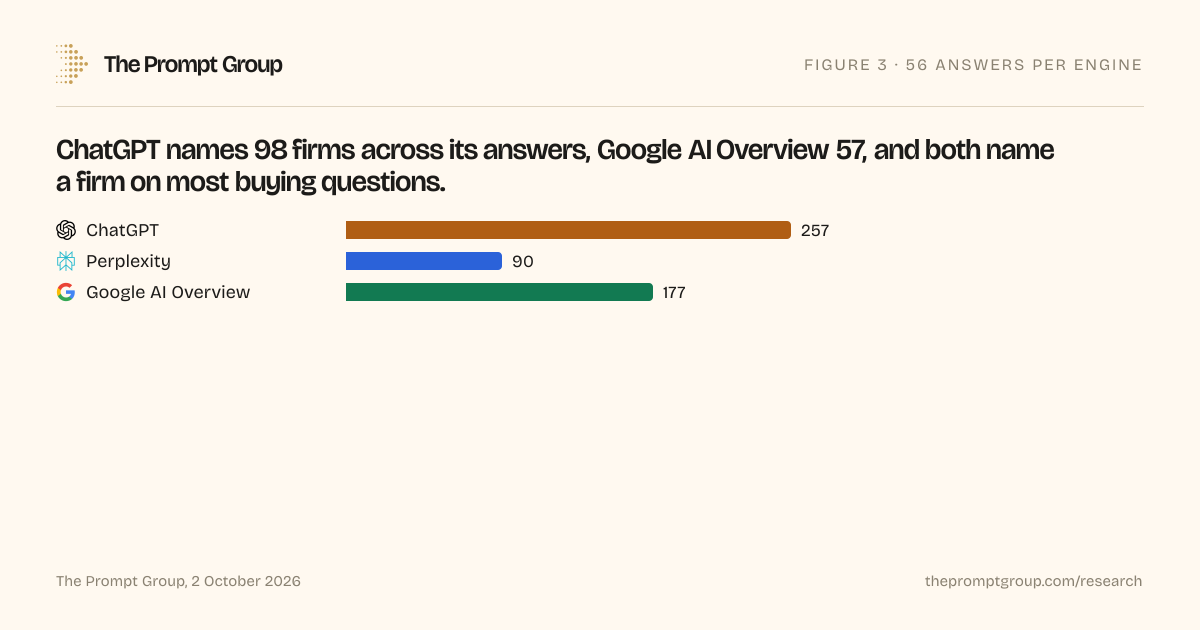
ChatGPT named 98 firms in 257 mentions, Google AI Overview 57 firms in 177 and Perplexity 63 firms in 90, each across 56 answers.
ChatGPT named at least one firm in 36 of its 56 answers and Google AI Overview in 34. On the commercial questions the two are almost level: ChatGPT named a firm in all 28 commercial answers and Google AI Overview in 27.
ChatGPT writes at length, with a median answer of 3,140 characters against 1,840 for Google AI Overview, and its shortlists are wider. Two Google AI Overview answers came back empty, and we cannot tell a refusal from a question that did not trigger an overview.
How much each engine names
ChatGPT names 98 firms across its answers, Google AI Overview 57, and both name a firm on most buying questions.
- 257ChatGPT
- 90Perplexity
- 177Google AI Overview
Data behind Figure 3
Firm mentions across each engine’s 56 answers, pooled over two runs. The Prompt Group, 2 October 2026.
| Name | Value | Firms named | Answers naming a firm |
|---|---|---|---|
| ChatGPT | 257 | 98 | 36 of 56 |
| Perplexity | 90 | 63 | 21 of 56 |
| Google AI Overview | 177 | 57 | 34 of 56 |
A longer answer names more firms, which suggests a single mention on ChatGPT says less about preference than a place on Google AI Overview’s shorter list. Being one of 57 firms Google AI Overview names is a narrower gate than being one of 98 on ChatGPT.
Which sources do AI answers cite about Canadian wealth management firms?
wsj.com, cited in 19.6 percent of 168 answers, ahead of the RBC Wealth Management site at 18.5, td.com at 16.7 and bmo.com at 14.9.
The answers carry 2,274 citations to 603 domains. ChatGPT accounts for 30 of the 33 answers citing wsj.com, and the pages are the paper’s US personal finance guides to choosing an advisor, including a review of a US firm. The regulator CIRO has the most citations of any domain, 192, concentrated in 24 answers, 14 of them to informational questions.
Five of the fifteen most cited domains are firm sites, all of them bank-owned except wellington-altus.ca, which is cited in 17 answers. Thirteen of its 18 cited pages sit on advisor team sites under advisor.wellington-altus.ca, not on the corporate site.
Most cited domains
A US newspaper’s advisor guides are cited in more answers than any Canadian firm or regulator.
- 01wsj.com19.6%
- 02rbcwealthmanagement.com18.5%
- 03td.com16.7%
- 04bmo.com14.9%
- 05ciro.ca14.3%
- 06wealthprofessional.ca14.3%
- 07canada.ca11.9%
- 08reddit.com11.3%
- 09wellington-altus.ca10.1%
- 10moneysense.ca10.1%
- 11advisor.ca8.9%
- 12linkedin.com8.9%
- 13cibc.com7.7%
- 14newswire.ca7.7%
- 15milliondollarjourney.com7.7%


Data behind Figure 4
Share of the 168 answers that cite each domain at least once, pooled over two runs. The Prompt Group, 2 October 2026.
A citation is a distinct page linked in an answer, counted once per answer. Subdomains count under their domain, so advisor.wellington-altus.ca is wellington-altus.ca. Type is our classification.
| Domain | Value | Citations | Pages cited |
|---|---|---|---|
| wsj.com | 19.6% | 104 | 11 |
| rbcwealthmanagement.com | 18.5% | 105 | 57 |
| td.com | 16.7% | 80 | 30 |
| bmo.com | 14.9% | 76 | 57 |
| ciro.ca | 14.3% | 192 | 101 |
| wealthprofessional.ca | 14.3% | 95 | 51 |
| canada.ca | 11.9% | 46 | 22 |
| reddit.com | 11.3% | 25 | 21 |
| wellington-altus.ca | 10.1% | 21 | 18 |
| moneysense.ca | 10.1% | 19 | 10 |
| advisor.ca | 8.9% | 35 | 23 |
| linkedin.com | 8.9% | 17 | 15 |
| cibc.com | 7.7% | 25 | 15 |
| newswire.ca | 7.7% | 17 | 11 |
| milliondollarjourney.com | 7.7% | 13 | 5 |
Wellington-Altus is named in 33 answers and its own site is cited in 17. RBC Wealth Management is named in 40 and its site cited in 31, TD Wealth in 30 and 28. Wellington-Altus appears to reach answers more through how others describe it than through its own pages.
The wsj.com guides suggest Canadian questions are being answered partly from American advice that no Canadian firm controls.
What kinds of sources do AI answers cite about Canadian wealth management firms?
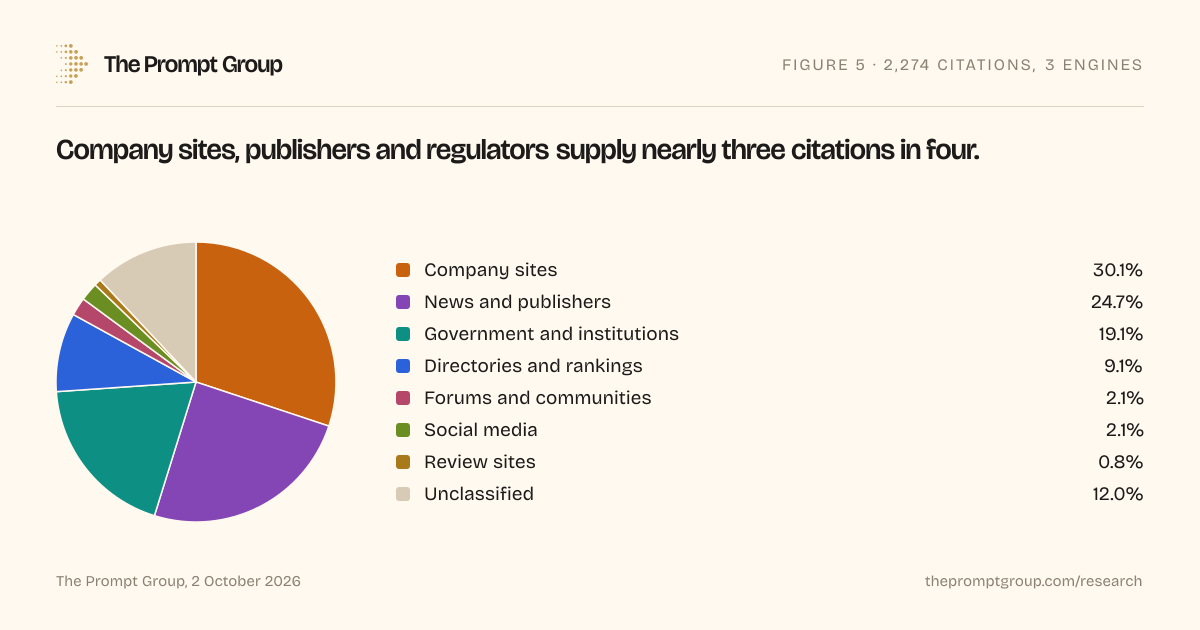
Company sites, with 30.1 percent of 2,274 citations, then news and publishers at 24.7 and government and institutions at 19.1.
The mix differs by engine. ChatGPT takes 36.5 percent of its citations from company sites and 24.7 percent from government and institutions, led by the regulator CIRO and canada.ca. Google AI Overview takes 10.5 percent from forums, reddit.com and Canadian personal finance forums, and 7.5 percent from social media, mostly LinkedIn, against 0.1 and 0.0 for ChatGPT.
Perplexity’s largest category is unclassified, at 36.4 percent, which is the unrelated sources described above. Review sites barely register on any engine, at 0.8 percent of all citations.
Sources by type
Company sites, publishers and regulators supply nearly three citations in four.
- Company sites30.1%684
- News and publishers24.7%562
- Government and institutions19.1%434
- Directories and rankings9.1%208
- Forums and communities2.1%47
- Social media2.1%48
- Review sites0.8%19
- Unclassified12.0%272
Data behind Figure 5
Share of all 2,274 citations by type of source, across three engines and two runs. The Prompt Group, 2 October 2026.
Type is set per domain: Searchable’s label where it gave one, carried to every engine, and our own label for the rest. Unclassified is the long tail neither covers.
| Name | Value | Citations |
|---|---|---|
| Company sites | 30.1% | 684 |
| News and publishers | 24.7% | 562 |
| Government and institutions | 19.1% | 434 |
| Directories and rankings | 9.1% | 208 |
| Forums and communities | 2.1% | 47 |
| Social media | 2.1% | 48 |
| Review sites | 0.8% | 19 |
| Unclassified | 12.0% | 272 |
The two engines that answer reliably build from different evidence. ChatGPT’s answers rest on what firms and regulators publish, while Google AI Overview gives a sixth of its citations to community discussion that no firm writes.
A firm can shape its own pages and its coverage in the trade press. It cannot write the Reddit threads Google AI Overview cites, only give those discussions accurate material to draw on.
What should a Canadian wealth management firm do about this?
Measure ChatGPT and Google AI Overview separately, on buying questions, and see which pages each engine cites before changing any.
Measure each engine as a separate market. Wellington-Altus is first on Google AI Overview and sixth on ChatGPT for the same 14 commercial questions, and TD Wealth moves from 35.7 percent to 8.9. A single blended score hides the engine a firm most needs to work on.
Track the buying questions. Commercial questions named a firm in 83.3 percent of answers and informational questions in 16.7 percent. A panel weighted towards definitions measures the part of the category where firms are rarely named at all.
Know which of your pages are cited. Wellington-Altus is named in 33 answers and its own domain is cited in 17, mostly through advisor team pages. Which pages the engines already cite is the first thing to check before writing new ones.
Check a collection before trusting it. In 32 of 56 Perplexity answers most of the cited sources were unrelated to the question. A visibility score built on that channel would have reported a collection failure as a market position.
How was this wealth management AI visibility study measured?
28 questions that name no firm, put to ChatGPT, Perplexity and Google AI Overview twice on 2 October 2026, giving 168 answers counted against a roster of 143 firms.
What we asked, word for word8 of the panel
- Who are the best wealth management firms in Canada?
- Best independent wealth management firms in Canada
- Which Canadian wealth management firms are not owned by a bank?
- Best private wealth management for high net worth Canadians
- Which wealth management firm in Canada is best for business owners?
- Should I move my portfolio from a bank to an independent wealth firm in Canada?
- Which wealth management firms in Canada have the lowest fees?
- How do I check if a financial advisor is registered in Canada?
- Panel
- 36 tracked questions written to match what a Canadian investor types on the way to choosing a wealth firm. The 28 that name no firm are the panel here. Four name Wellington-Altus and four name Richardson Wealth, Assante, Harbourfront or CI Financial, and all eight are set aside.
- Topics and intent
- Firm comparison and reputation 9 questions, choosing an advisor 6, high net worth and business owners 6, fees and cost 4, independent against bank 4, corporate ownership 1. Questions can carry more than one topic, so those do not add to 28. Searchable labels 14 questions commercial, 9 informational and 5 transactional, and those labels are the platform’s.
- Geography
- Run with the country set to Canada and the language set to English (Canada). Three questions name a city, Toronto, Vancouver and Calgary, and none names another country.
- Collection
- Two runs on 2 October 2026, at about 5 pm and 8 pm Eastern. 28 questions across three engines, twice, is 168 answers, 56 per engine. Two Google AI Overview answers came back empty.
- Answer share
- The percentage of the 168 answers, or of one engine’s 56, in which a firm was named. It is not market share, assets or client count. One answer can name several firms, so shares do not sum to 100.
- How firms were counted
- Searchable matches each answer against a roster of 143 firms built for this project, so a firm outside the roster is not counted however often it is named. We checked the match for eight firms against the answer text and found no false matches, though it misses some division names. Firm names follow the roster.
- Ownership groups
- Bank-owned, not bank-owned and online platform are our classification, by ownership as of October 2026. Richardson Wealth, owned by iA Financial Group, counts as not bank-owned.
- Citations
- A citation is a distinct page linked in an answer, counted once per answer. ChatGPT often links the same page twice with different tracking tags, so the 2,827 links recorded become 2,274 citations. Subdomains count under their registrable domain.
- Source types
- Each cited domain gets one type: Searchable’s label where it gave one, carried to every engine, fixed lists for social networks and forums, and our own label for 39 more domains. The 272 citations neither covers are unclassified, and the hand labels are published with the data.
- What we read
- We read all 56 Perplexity answers with their sources, and every answer that names Wellington-Altus, 33 in all. The Perplexity classification is ours and is published with the data.
- Frozen extract
- The project keeps collecting. These figures are the two runs of 2 October 2026, pulled through the Searchable API on 3 October and available on request.
- Limitations
- Two runs three hours apart is one collection moment, and the engines moved between them: RBC Wealth Management was named in 16 answers in the first run and 24 in the second, TD Wealth in 18 and 12. Read the order inside the top five as a tie and differences under three points as noise. Perplexity’s answers mostly failed to retrieve relevant sources, so its figures describe the collection rather than Perplexity, and the pooled shares carry that defect. The firm roster was built around Wellington-Altus’s domain and its competitors, so a firm outside it is not counted; 156 firms matched, and the true number named is higher. The panel is 28 questions, and fourteen of them carry almost all the firm mentions.
Cite this report
Sopov, A. (2026). The Prompt Group Research. https://thepromptgroup.com/research/wealth-management-firms/ca
Figures and data are free to reuse with attribution under CC BY 4.0. Every chart is available as a PNG carrying its source line, and every dataset as CSV and JSON.
What do people ask about AI search and Canadian wealth management firms?
Which firm each AI engine names in Canada, which sources it cites, and how a firm should read its own visibility, all from the 2 October 2026 collection.
Which wealth management firm does AI recommend in Canada?
No single firm. Across 168 answers to 28 unbranded questions on 2 October 2026, RBC Wealth Management was named in 23.8 percent, BMO Private Wealth in 20.8, Wellington-Altus in 19.6, CIBC Wood Gundy in 18.5 and TD Wealth in 17.9.
Which wealth management firm does ChatGPT recommend in Canada?
RBC Wealth Management and TD Wealth, each named in 35.7 percent of ChatGPT’s 56 answers on 2 October 2026, ahead of BMO Private Wealth at 33.9. Wellington-Altus was named in 23.2 percent.
Which wealth management firm does Google AI Overview name in Canada?
Wellington-Altus, named in 33.9 percent of Google AI Overview’s 56 answers on 2 October 2026, ahead of Nicola Wealth at 25.0 and CIBC Wood Gundy at 23.2. TD Wealth was named in 8.9 percent.
Does AI recommend bank-owned or independent wealth firms in Canada?
Both. Four of the five most named firms are bank-owned, and Wellington-Altus is the fifth. Bank-owned firms took 35.4 percent of firm mentions on ChatGPT and 28.8 percent on Google AI Overview, under our classification.
Which sources does AI cite about Canadian wealth management?
wsj.com was cited in 19.6 percent of 168 answers, mostly by ChatGPT and mostly from US advisor guides. The RBC Wealth Management site followed at 18.5 percent, td.com at 16.7 and the regulator CIRO at 14.3.
How should a wealth management firm measure its AI visibility?
Engine by engine, on buying questions. ChatGPT and Google AI Overview put different firms first, and questions that ask for a firm name one 83.3 percent of the time against 16.7 for definitional questions.

Written by
Founder, The Prompt Group
Anton Sopov is the founder of The Prompt Group, an AI brand strategy and agentic discovery firm. He works with brands on how they are ranked, cited and described in ChatGPT, Claude, Gemini and Perplexity answers, and is the author of The Delegation Curve.
 Canada
 United States
 United Kingdom
 Australia